

A confidential presentation from a 2023 transgender-medicine conference provides a unique and eye-opening window into how self-identified activist care providers have sought to overhaul and minimize the process of assessing youth who seek gender-transition interventions.
I obtained a video of this presentation, the slides of which are all labeled with the admonition “DO NOT COPY OR RECORD,” along with hundreds of other conference videos thanks to a subpoena that the Alabama attorney general waged in a lawsuit over that state’s ban on pediatric gender transition treatments. The videos come from 2021 to 2023 conferences held by the World Professional Association for Transgender Health (WPATH) and its U.S. offshoot, USPATH.
I reviewed all the videos pertaining to pediatrics and covered them in an article for Compact magazine, which I encourage you to read. I am otherwise publishing the most notable of the conference videos on my Substack. I will put links to all of them on this landing page if you want to bookmark that for future reference. This is the fourth video in the series.

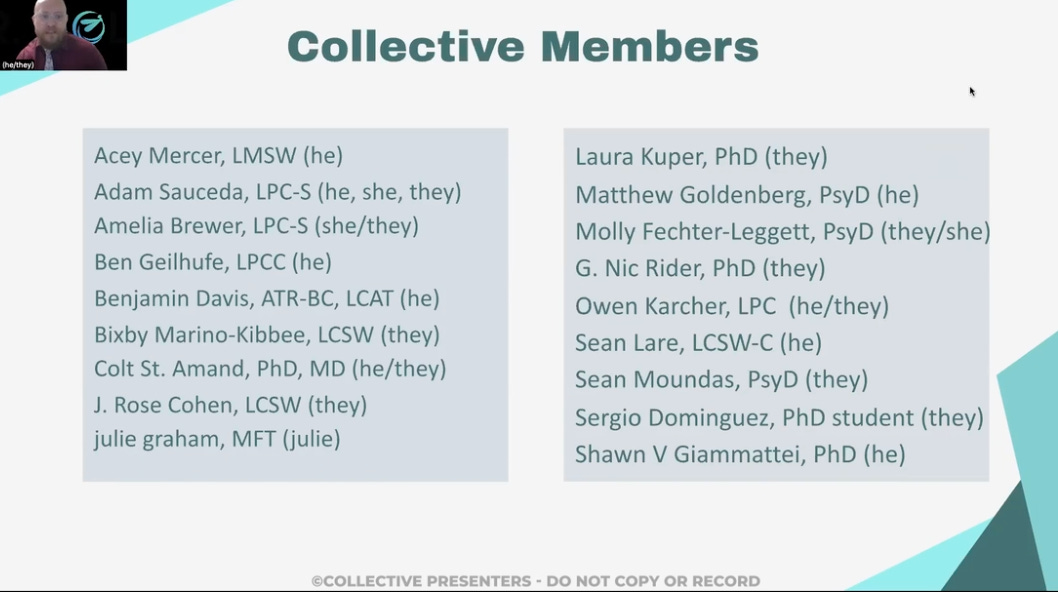
In this video, a team of six self-described “providers, clients, advocates and activists” presented an assessment model at the 2023 USPATH conference that a collective of them had spent two years developing. Dr. Colt St. Amand, a psychologist and family medicine doctor in New York state, introduced the session, cautioning attendees to keep a lid on it: “By viewing this presentation, you also agree not to record or photograph or transmit any portion of the presentation or the slide deck or conversations among the participants,” he said. Here are the collective members:
Here Dr. St. Amand is speaking about addressing youths’ “embodiment goals:
WPATH’s 2022 trans-care guidelines recommend a comprehensive biopsychosocial assessment for all minors seeking access to gender-transition interventions. However, as I wrote in Compact, many presenters at the WPATH and USPATH conferences seemed eager to chip away at these assessments:
But the conference videos suggest a gulf between WPATH’s guidance and actual practice by at least some in its membership. Dr. Scott Leibowitz, a child psychiatrist, current WPATH board member, and coauthor of the 2022 guidelines’ adolescent chapter, said at the 2023 training conference that the guidelines are “very flexible” and essentially aspirational.
“What we’re putting forward is more of a gold standard—not necessarily: ‘You must do this,’” Leibowitz said.
Even presenters who favored a more cautious and circumspect approach often characterized assessments primarily as a conduit for individualizing care. They rarely made clear that the assessments were at least partly meant to prevent poor outcomes by selecting out those who didn’t meet diagnostic criteria.
Indeed, the presenters in this session eyed assessments warily. Like many presenters at these conferences, they were eager to disparage any effort to assess whether a child is truly transgender. Similarly, they were dismissive of any suggestion that a trans identity in a young person might be an outgrowth of a deeper psychopathology.
Laura Kuper, a psychologist at UT Southwestern Medical Center and a coauthor of the WPATH trans-care guidelines’ nonbinary chapter said in the 2023 video: “Assessment of someone’s gender identity from the perspective that providers have an ability to discern some true identity that exists beyond what is articulated by the person—and related to that attempts to identify root causes of gender identity, expression, or embodiment that would somehow disqualify one from treatment when they are otherwise able to articulate their treatment goals and provide informed consent.” Dr. Kuper said that “these conceptualizations reflect a pathologizing lens. And we find them inconsistent with that perspective of cultural humility.”
Listen to this episode with a 7-day free trial
Subscribe to Hazard Ratio: Benjamin Ryan to listen to this post and get 7 days of free access to the full post archives.


