

Hazard Ratio is a reader-supported Substack. Consider backing my work and becoming a paid subscriber today.
When I was in the 7th grade in 1991, my terrific social studies teacher, Mr. Corkran, taught us what plagiarism was and why it was to be avoided at all costs. And importantly, he taught us strategies—which I still use today—for how to avoid even inadvertently plagiarizing, such as taking notes from another text only in paraphrase. That way you don’t later forget that what you jotted down was someone else’s verbatim text.
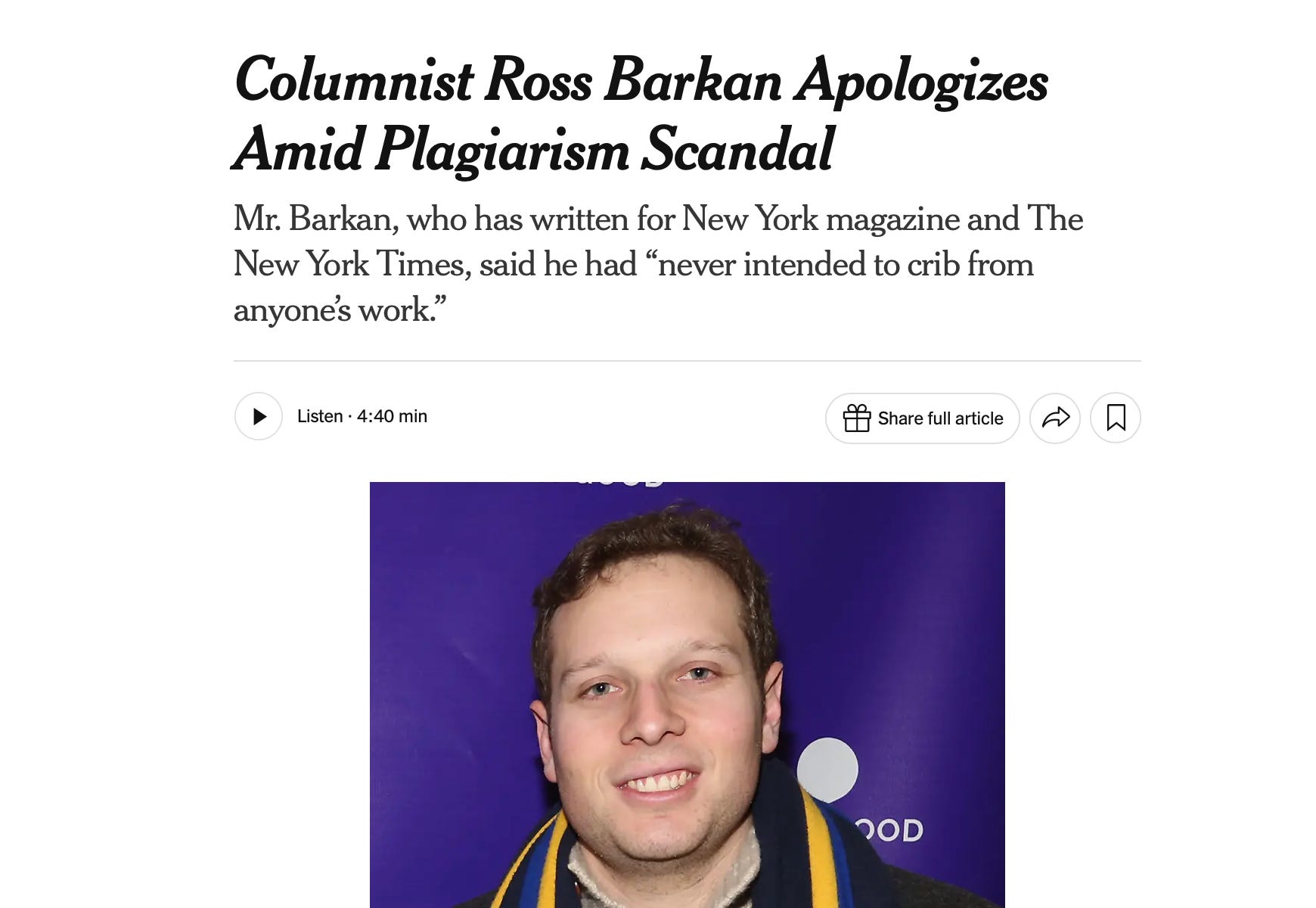
I wish everybody had had Mr. Corkran as a teacher. It would’ve saved, perhaps, left-wing pundit Ross Barkan from getting fired from New York magazine after they found 67 columns of his had citation problems, and also from having Penguin announce this week, per the Washington Post, it was shelving his upcoming book about his longtime friend Zohran Mamdani. When Mr. Barkan was first found out in the spring, he tried to make out like it didn’t matter if he had clearly lifted verbatim passages from another writer absent quotation marks around the text, so long, he said, as he cited them explicitly or hyperlinked to them. Mr. Corkran would tell him that is not a loophole in the plagiarism rules!
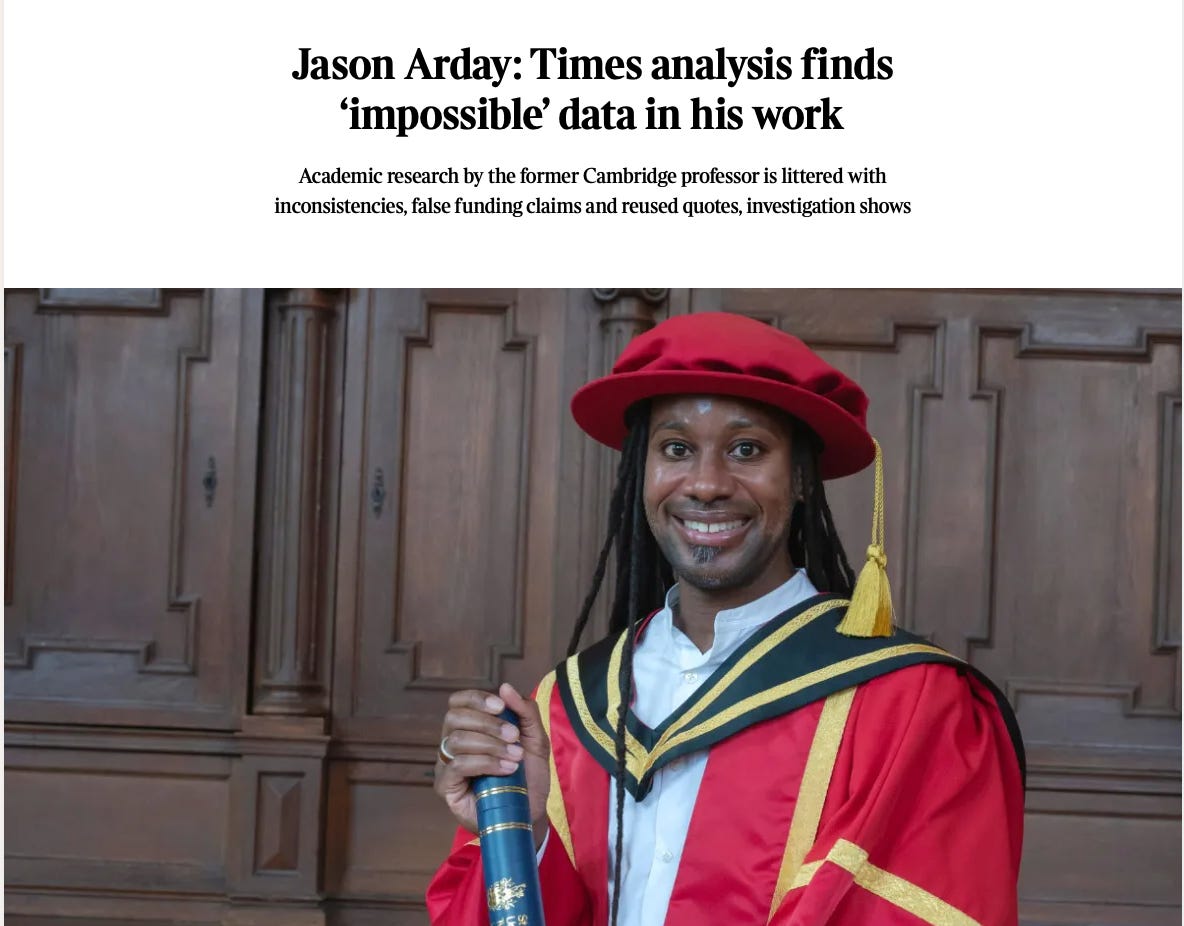
The Jason Arday affair is much more complicated and ethically fraught, given, in part, that I find it hard to believe any of the sweeping overlap in the text between his work and other scholars’ papers was ever inadvertent—Liverpool John Moores University’s baffling decision to clear him of plagiarism charges on his 2015 PhD thesis notwithstanding.


As everyone takes sides in the aftermath of Dr. Arday’s August 14 death—an apparent suicide—it seems that multiple academics in good standing have missed the message that plagiarism, by definition, can include, absent the stealing of ideas, the mere lifting of someone else’s words if that verbatim text is not put within quotation marks.
Take Jason Stanley, a professor of philosophy at the University of Toronto. To my amazement, Dr. Stanley wrote the following in his rambling and poorly informed piece about the late Dr. Arday this week (bolding of text is mine, the italics are his):
Plagiarism is the stealing of ideas or research programs. But in recent years, AI has enabled malignant actors to target people in academia for overlap of sentences, even when the overlapping of sentences has no bearing whatsoever on the stealing of ideas or research programs. The original meaning of plagiarism does not cover mere overlap of sentences.
You know who disagrees with Dr. Stanley? His employer, the University of Toronto. The university defines plagiarism in its Code of Behavior for Academic Matters like this (bolding mine): “It shall be an offence for a student knowingly: …to represent as one’s own any idea or expression of an idea or work of another in any academic examination or term test or in connection with any other form of academic work.”

The “work of another” refers, at least in part, to the mere words someone uses, without the need to have stolen their ideas, per se. (I do find it odd, mind you, that the university’s code of conduct requires that the student knowingly plagiarized; this seems to leave the door open for sloppiness leading to inadvertent plagiarism. Mr. Corkran would not approve.)
The University of Toronto’s “How Not to Plagiarize” guidance for students advises (bolding mine): “If you use the author’s exact words, enclose them in quotation marks, or indent passages of more than four lines.” And: “If you record a phrase or sentence you might want to quote, put quotation marks around it in your notes to remind yourself that you’re copying the author’s exact words.”
Mr. Corkran would approve!
Another false claim by a professor: “Plagiarism is not using the same phrase that somebody else has used in a previous article.”
Additionally, I obtained a video recording of a fraught and impassioned planning meeting, held Tuesday, of the UCU Solidarity Movement—an activist collective of the University and College Union, the largest higher-education union in Britain—in which two professors claimed a similarly narrow definition of plagiarism that excluded the mere overlap of text. And yet none of the other dozens of academics on this Zoom meeting objected to this narrow definition. Instead, one Cambridge professor seemed delighted that they were at least moving the plagiarism conversation away from textual overlap and recentering it on the stealing of ideas. (Dr. Arday stood credibly accused of stealing both the words and the research of other academics, mind you, per a devastating investigation by The Times. No one in the meeting specifically acknowledged that his accused offenses were this broad in scale.)
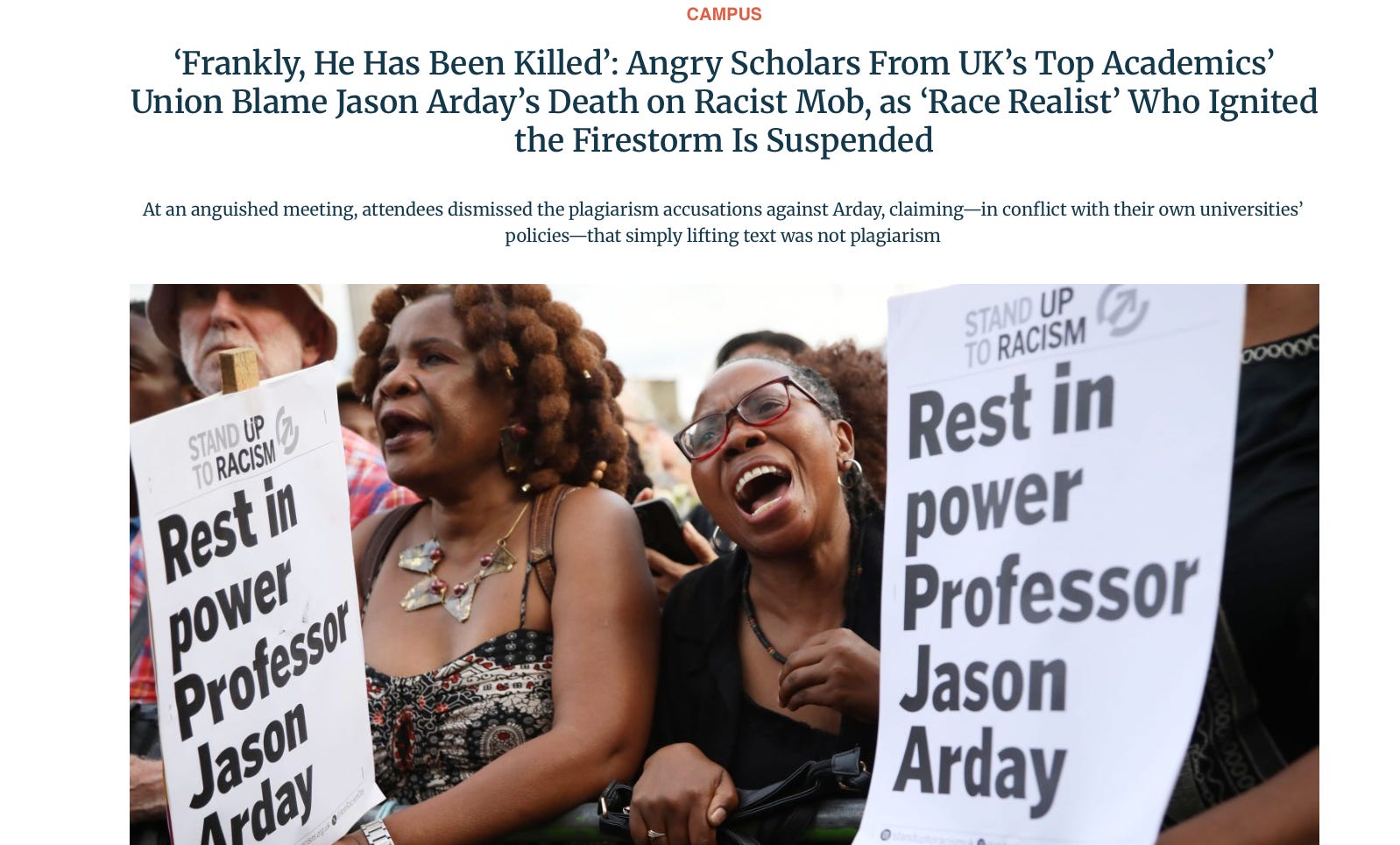
I reported on this nearly two-hour UCU planning meeting, which was meant as a response to Dr. Arday’s death and to prepare the activist members to defend any other black scholars who might be accused of academic misconduct, in an article published in The Washington Free Beacon today: “Frankly, He Has Been Killed’: Angry Scholars From UK’s Top Academics’ Union Blame Jason Arday’s Death on Racist Mob, as ‘Race Realist’ Who Ignited the Firestorm Is Suspended.” I encourage you to read the piece.
Sean Wallis, who organized the meeting, is a principal research fellow in the University College London’s English department, the UCL branch secretary of the UCU, and sits on the union’s national executive committee. So he is no slouch. The most astonishing single thing Dr. Wallis said about plagiarism during Tuesday’s planning meeting was: “Plagiarism is not using the same phrase that somebody else has used in a previous article.”
See this quote in the video below:
Dr. Wallis and Lyes Kahouadji, who researches chemical engineering at Imperial College London, had a more extended exchange during the meeting about what plagiarism is and isn’t that I summed up in my Free Beacon article like this:
Wallis appeared to defend Arday by offering a narrow definition of plagiarism. He brought up plagiarism-detection software (which Cofnas used to identify similarities between Arday’s thesis and the work of another scholar) and noted that such programs detect “textual overlap.” But, he said, “textual overlap is not necessarily plagiarism. Plagiarism is the theft of ideas, theoretical research ideas. It’s the theft of intellectual work.”
A number of attendees then nodded their heads. Eva Hartmann, a university associate professor in Cambridge’s education department, where Arday served until resigning August 5, smiled and gave a thumbs up in response.
“Plagiarism is not using the same phrase that somebody else has used in a previous article,” Wallis continued. He cited Galileo (who was prosecuted for heresy), saying the Renaissance scholar had his students copy his texts to teach them to craft scientific prose. “And actually, that’s been a long-standing way of teaching for quite a long time,” Wallis said. “So it’s not surprising that people will do more textual overlap than they realize.”
Plagiarism-detection software, Wallis said, has “substituted a proper understanding of what plagiarism is—that is, the passing off of other people’s research ideas as your own, stealing them and publishing them for something else—which is, like I say, textual repetition or paraphrasing, failing to cite adequately. They’re not the same sin. Deliberate stealing of ideas is not the same.”
Lyes Kahouadji, a chemical engineering researcher at Imperial College London, who is non-white and whom Wallis appointed to chair the meeting, later replied to Wallis that “it’s really important what you mentioned about textual overlap and plagiarism.” Kahouadji insisted that plagiarism is “completely different, and academics are supposed to come forward and say, ‘No, this is not plagiarism.’” Regarding Arday, he continued: “It’s really a shame that people who are supposed to protect from this plagiarism fantasy didn’t speak up.”
All of the academic institutions where Wallis, Kahouadji, and Hartmann work, as well as Liverpool John Moores University, from which Arday received his Ph.D., clearly and explicitly define plagiarism as including the lifting of text without clear attribution.
Cambridge defines plagiarism as “using someone else’s ideas, words, data, or other material produced by them without acknowledgement.” UCL’s guidancestates: “Plagiarism is the presentation of another person’s thoughts or words or artefacts or software as though they were your own.”
In a statement to the Free Beacon, a representative for UCL—the only institution other than Ghent named in this report to return a request for comment—said, “Academic misconduct, including plagiarism, is taken seriously and is addressed through established university procedures. Alongside these policies, UCL provides research integrity training for research staff and students across all disciplines.”
I rest my case.
Here is a video of the full exchange:
And here is the full transcript of this video (which is a complication of several exchanges but which includes all necessary context):
Sean Wallis (UCL branch secretary, UCU national executive committee)
“Turnitin is a plagiarism detection software, but it doesn’t actually detect plagiarism. It detects textual overlap. Textual overlap is not necessarily plagiarism. Plagiarism is the theft of ideas, theoretical research ideas. It’s the theft of intellectual work. Right? That’s what plagiarism is? Plagiarism is not using the same phrase that somebody else has used in a previous article.”
Sean Wallis
“We have to be absolutely clear. We will support them [black academics accused of academic misconduct], oppose any kind of trial by media, trial by social media, any kind of attack of that kind, and we will defend their right to a due process within the university, and we will distinguish between genuine plagiarism and accidental textual overlap. Right? It happens all the time. And here’s the thing: I’m not going to defend plagiarism. I fought, you know, I fought for intellectual academic freedom for all my life, right?”
“I tell you what, though, I was reading about Galileo, and you know what Galileo did with his students? He got them to copy his texts to teach them how to write in a scientific way. And actually, that’s been a long-standing way of teaching for quite a long time. So it’s not surprising that people will do more textual overlap than they realize.”
“And the point is, what’s happened with these technologies is that we’ve substituted a proper understanding of what plagiarism is — that is, the passing off of other people’s research ideas as your own, stealing them and publishing them for something else — which is like I say, textual repetition or paraphrasing, failing to cite adequately. Yeah, they’re not the same sin, okay? Deliberate stealing of ideas is not the same, and we have to fight to re-establish basic principles.”
Lyes Kahouadji (Imperial College; chairing the meeting)
“It’s really important what you mentioned about textual overlap and plagiarism. It’s completely different, and those academics who [are] supposed to come forward and say no, this is not plagiarism. We know even the referees who read his work — or something — they should have come forward.”
Lyes Kahouadji
“I never heard about Jason, Professor Jason Arday before. I’m working in engineering. He was in different uni and different topics. I never heard of him until this week, and through social media, and then someone has resigned because of plagiarism, and then when you see it has been cleared of all plagiarism, and the campaign continued. I had the graphic that I found — the amount of articles, the harassment. Frankly, he has been killed. For me, it’s not the suicide. It’s the society who killed him, by abandon him, by all the harassment. Even he thought resigning, it will be the end of it. It becomes worse.”
Lyes Kahouadji
“It’s really [a] shame that people who are supposed to protect from this plagiarism fantasy didn’t speak up, and for people who has nothing to do with science — speak up, spoke up.”
“What a shame. I think this is one of the darkest times in history of UK academic.”
I am an independent journalist, specializing in science and health care coverage. I contribute to The New York Times, NBC News, The Free Press, UnHerd and The New York Sun. I have also written for the Washington Post, The Atlantic, The Guardian and The Nation, among many others. Follow me on X: @benryanwriter. Visit my website: benryan.net


