

In a panel discussion at the 2022 World Professional Association for Transgender Health, or WPATH, conference, a quartet of women lamented what they characterized as the misuse of science in the law where pediatric gender medicine was concerned.
As an antidote, they frequently offered misinformation of their own, or at the very least made non-evidence-based claims.
This video of the conference session in question is the latest in an ongoing series I’m publishing of conference videos from WPATH and its US offshoot, USPATH, spanning 2021 to 2023. I covered the full scope of these videos as they applied to pediatric gender medicine in a recent article for Compact magazine. You can find the full roster of the videos I’ve published thus far here:

The title of the panel I’m focusing on in this Substack was: “When Science is Misused in law: How to Address the Biased Science that Underlies Legal Bans on Gender-Affirming Care for Youth.”
The panel was moderated by Anne L. Alstott, a professor at Yale Law School and included:
Jennifer Levi, the director of the transgender rights program at GLAD, the LGBTQ legal advocacy group
Dr. Christy Olezeski, an associate professor of psychiatry and the director of the Yale Pediatric Gender Program (she was on the program but wasn’t in attendance)
Dr. Meredithe McNamara, an assistant professor of pediatrics at Yale (who presented Dr. Olezeski’s slides and her own presentation)
Dr. Nathalie Szilagyi, an instructor at the Yale Child Study Center
Dr. McNamara in particular has established herself as one of the leading voices straddling medicine and policy in the effort to protect minors’ access to gender-transition treatments. In recent years, she has often served as a paid expert witness in legal settings defending the medical field—a practice that is highly lucrative for witnesses on either side of this dispute.
Ms. Alstott and Dr. McNamara are the cofounders of The Integrity Project, which acts as a kind of rapid-response hub in the face of legal and scientific threats to pediatric gender medicine. The project is most known for putting out a white paper criticizing Britain’s Cass Review of this field.
Jesse Singal has subjected that particular white paper to a withering three-part critique in which he said that it was guilty of spreading reams of misinformation.
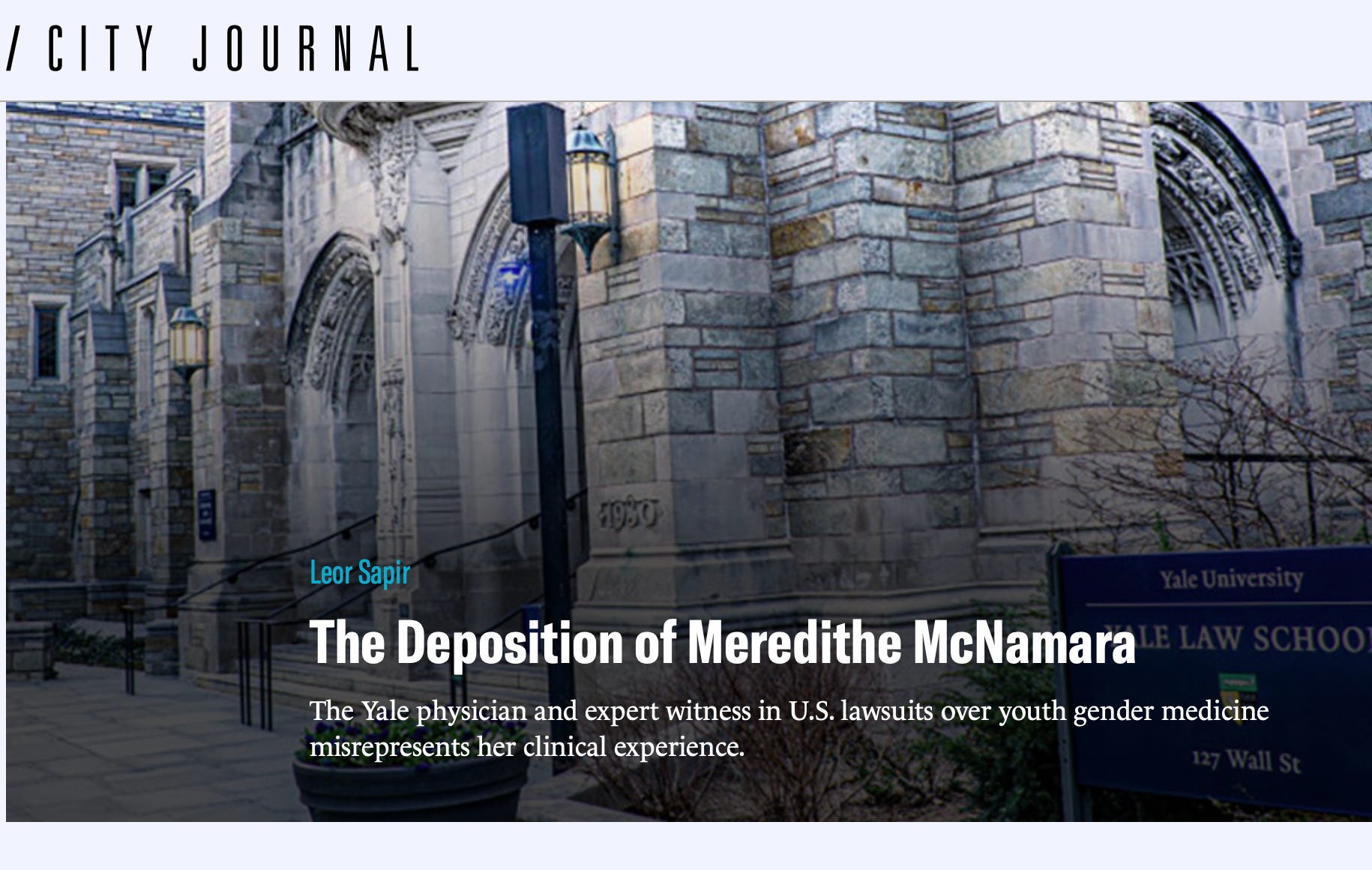
The Manhattan Institute’s Leor Sapir published a scathing account of what he characterized as Dr. McNamara’s misrepresentation of her clinical experience. In an August 2024 article in City Journal, Dr. Sapir analyzed a deposition that Dr. McNamara gave in the federal lawsuit over Alabama’s ban of gender-transition interventions for minors. Most notably, Dr. Sapir focused on Dr. McNamara’s admission that she did not provide gender-affirming care herself; and since 2021, she had only ever referred two minors to a pediatric gender clinic.
This admission is remarkable, given that Dr. McNamara has often suggested she is a hands-on expert in pediatric gender medicine. And indeed, in the 2022 WPATH panel, she suggested she was one.
What amazed me about this conference panel was how seldom the speakers rebutted misinformation with substantive information of their own. Oftentimes they simply sweepingly declared something untrue and expected the audience to take it on faith that this was an accurate assertion. This was not an unreasonable presumption, given how WPATH conference-goers almost never challenged the ideas of presenters—at least in the well over 100 videos that I watched during my reporting for Compact.
The 2022 legal panel was based on a certain bedrock of confidence among the speakers that their methods of combatting what they asserted was misinformation would help their movement prevail in the face of major, mounting political attacks on pediatric gender medicine. And while hindsight is 20/20, it is now clear that they were being wholly naive about just how aggressive—and ultimately successful—their opponents would be in this fight.
Little did they know that they were waging a fast-losing battle.
Jennifer Levi
Ms. Levi expressed her dismay over what she characterized as “a coordinated, nationwide strategy to roll back protections” for the transgender community. This included attacks on pediatric gender medicine; school-related legislation that governed, for example, what could be addressed regarding LGBTQ issues in the classroom; and restrictions on cross-sex sports participation.
Regarding sports-related laws, Ms. Levi said, “The only tiny sliver of light here is that where these laws are challenged, courts have seen the bans for the bias that they reflect.”
In the coming weeks, the nation will see the culmination of that fight when the Supreme Court issues its ruling about the constitutionality of sex-based restrictions on sports participation and whether such restrictions square with Title IX. Legal experts expect the transgender plaintiffs will likely lose.
Speaking to laws banning pediatric gender-transition interventions, Ms. Levi said, “Proponents of these discriminatory laws and defenders of these discriminatory laws are actually abusing and misusing research to distort the truth and the underlying facts about transgender young people and the well-established medical care that many young people need.”
It is safe to say that Ms. Levi’s next assertion is contradicted by multiple systematic literature reviews of this medical field, which have found the evidence backing gender-transition interventions for minors wanting and uncertain. Journalist Jennifer Block reported in BMJ in 2023, for one, that gender-transition treatment cannot be considered evidence based.


