
History Is Repeating Itself In the Battle Over Conversion Therapy
The mental health profession learned a hard lesson after mistreating gay people during the 20th century, only to repeat those same mistakes—albeit in the name of undoing them—with trans patients.

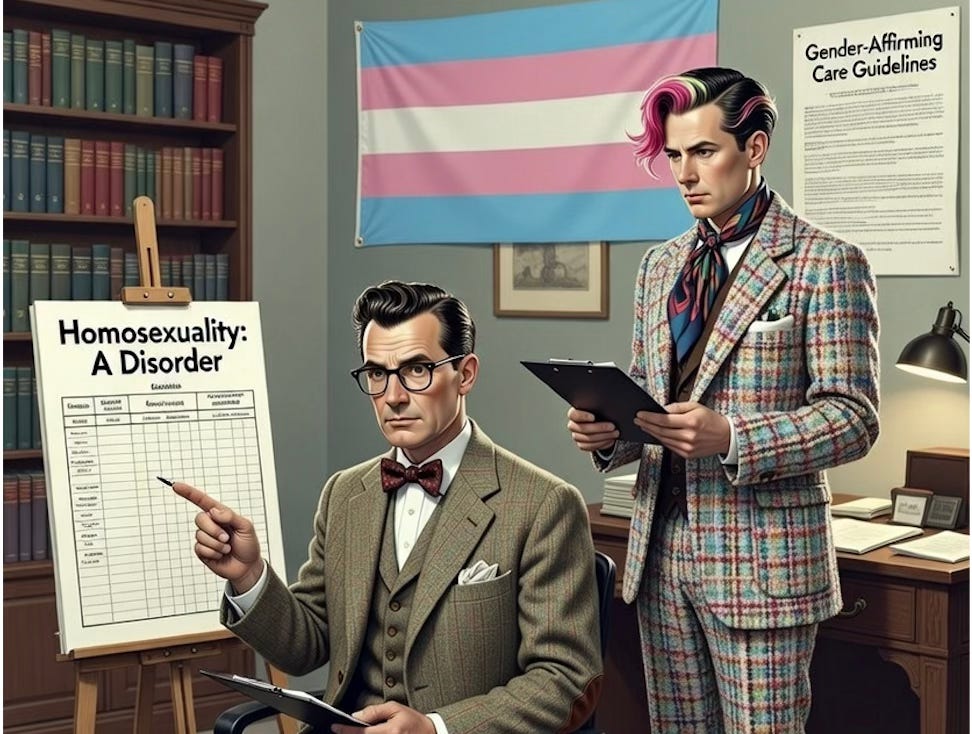
This is a guest post by Australian psychologist Roberto D’Angelo (no relation to Robin DiAngelo), adapted from his recent paper, “Trans is not the new gay.”
Gender-affirming medical and surgical interventions for young people have been championed by medical and LGBT+ organizations alike. However, the certainty that these treatments are beneficial and life saving has been increasingly undermined by a series of systematic reviews of the scientific evidence.
The recent successful litigation in New York state by Fox Varian, a woman who claimed harm by a gender-transition mastectomy, should prompt us to consider how this treatment, supported by limited evidence, was embraced by the medical and mental health communities, and how we can prevent further harm to individuals with diverse sexualities and gender identities.

During the mid-20th century, most psychiatrists and psychoanalysts viewed homosexuality as a disorder requiring treatment. Gay patients were subjected to unhelpful and harmful interventions. This care approach remained resistant to change for decades, despite an increasing body of empirical scientific evidence contradicting the psychoanalytic position on homosexuality. Analysts rejected empirical science, regarding it as inferior to psychoanalytic understandings of the unconscious. They believed that they possessed privileged knowledge about how the mind worked.
Fast forward half a century. History is repeating itself, except this time it involves transgender youth rather than gay and lesbian adults. Just as analysts were committed to their stance on homosexuality, mainstream clinicians today are staunch defenders of the gender-affirming approach to gender dysphoria. According to this ethos, all diverse experiences of gender should be accepted and affirmed, including through medical and surgical interventions, if desired. Any empirical data (or the glaring lack of it) that challenges this position is dismissed, and clinicians who advocate caution are regarded as misinformed, uninformed, or bigoted.
Trans issues are presented as the contemporary equivalent of the post-Stonewall gay rights movement that culminated in the legalization of same-sex marriage. Just as we eventually stopped trying to ‘cure’ homosexuality, the thinking goes, we should stop recommending—or requiring, as a precondition for transition interventions—psychotherapy to people with gender dysphoria and trans identities. However, this is a false equivalence, as I demonstrate in my paper, “Trans is not the new gay” published in The International Journal of Psychoanalysis last month. To promote this agenda, the same defensive tactics that allowed the pathologizing view of homosexuality to persist for decades, before the mental health profession stopped perpetuating that particular strain of harm, are now being used to protect the mainstream approach to gender distress from being revised and corrected.
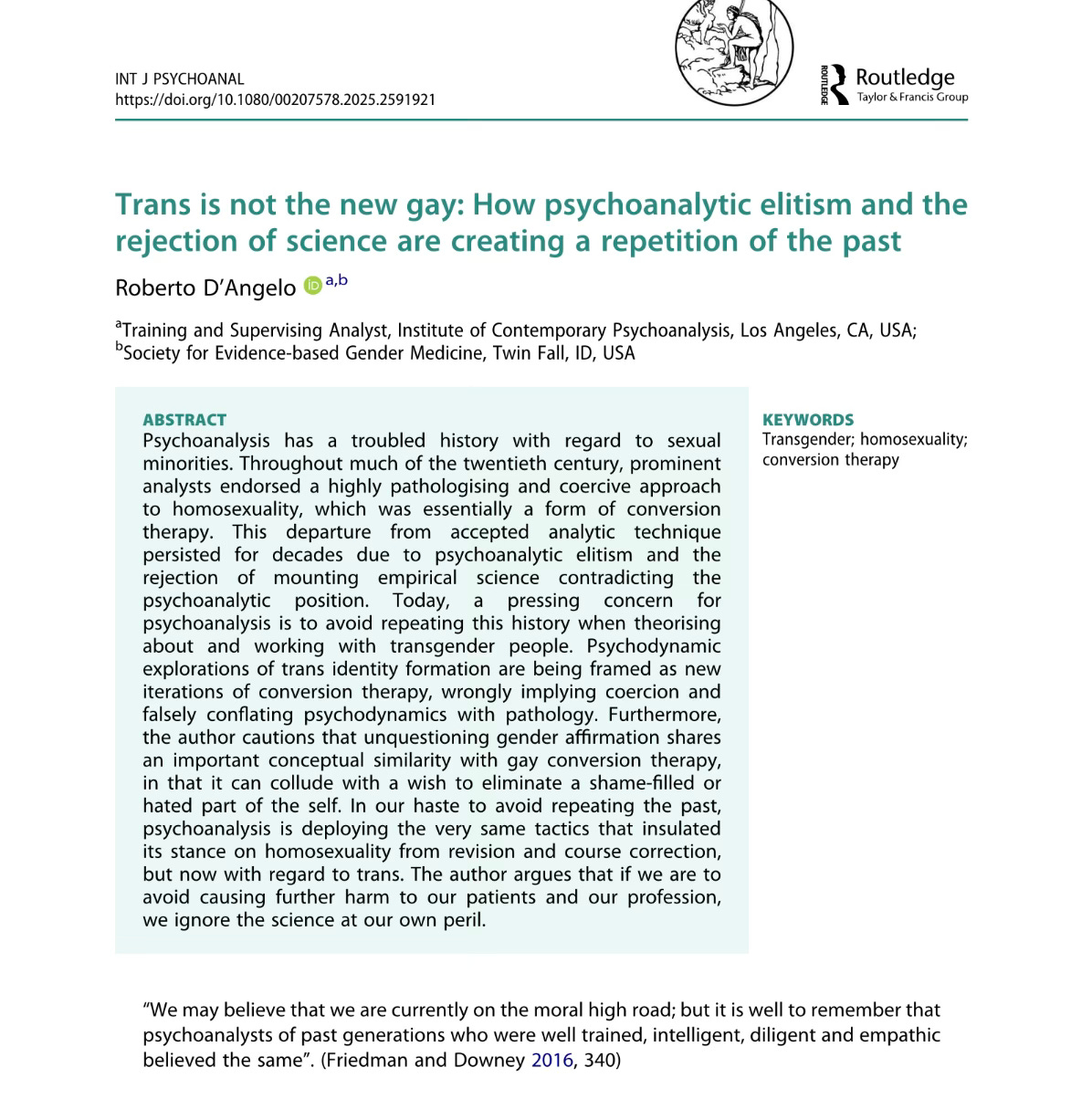
Our shameful history with homosexuality is being invoked as a warning not to repeat the grievous errors of the past when it comes to gender-diverse young people. Ironically, however, the medical profession’s zeal to avoid repeating the past is generating a repetition of the very thing we hoped to avoid.
The confusion between psychotherapy and conversion therapy
Advocates of the gender-affirming position have generated intense concern within our community about conversion therapies, meaning treatments intended to change someone’s sexual orientation or gender identity. They claim that therapies that explore the psychological and psychodynamic underpinnings of diverse gender identities are actually covert forms of conversion therapy.
This politically charged message is misleading and based on incorrect assumptions. Firstly, all aspects of human experience and personality are shaped by a multitude of factors, including positive and negative experiences, relationships, education and culture. This applies just as much to conventional gender identities as it does to transgender identities and to gay and lesbian people as it does to straight people. Those who advocate for gender-affirming care argue that attempting to understand why someone feels so uncomfortable with their gender and body that they wish to change it is really about trying to eradicate gender diversity. In their view, exploring psychodynamics equals a search for psychopathology. For psychodynamic therapists like me, illuminating psychodynamics is not about rooting out pathology, but about expanding self-understanding. Knowing ourselves, including why we feel the way we do and what drives our internal struggles, gives us greater freedom of choice, thereby supporting autonomy.

Psychoanalysts who attempted to cure homosexuality in the 20th century—the exemplar of psychotherapeutic conversion therapy—practiced in a way that was a highly problematic departure from accepted practice. Therapists are trained to be neutral, curious, and reflective. The approach to homosexuality practiced by analysts who sought to cure it was none of these things; it was coercive and exploited the power imbalance inherent in the therapeutic relationship. Patients were repeatedly reminded of the pathological nature of their same-sex desire, coached to date and have sex with members of the opposite sex, and threatened with the termination of therapy if they did not try hard enough. Importantly, I have been unable to find any contemporary psychotherapy publications recommending this kind of coercive approach to gender dysphoria.
This bears repeating: Actual psychotherapy is not conversion therapy, and actual conversion therapy is not psychotherapy.
How we respond to homosexuality and trans experience
Psychologically, many people with gender dysphoria and people struggling with same-sex attraction can be described as “internally divided”. Both are struggling with a shame-filled, hated, unwanted part of themselves. For gay people, it is their same-sex desire and everything it represents. For people with gender dysphoria, it is their natal sex — especially as represented by their sexed body — that often evokes shame, disgust, and horror. Many of the young people I have worked with have described wanting to rid themselves of their natal sex as much as they want to transition to their new gender. Indeed, the new gender generally offers the hope of a future in which the natal sex has been completely eradicated.
And yet, these similarities notwithstanding, the difference in the way we respond to these two groups is profound. Psychotherapies mostly work towards what is known as integration, helping people to accept all aspects of themselves, whether they are perceived as positive or negative. With gay and lesbian people, we help them embrace their sexual orientation, a part of themselves that often feels shameful and unwanted. By contrast, when working with young people struggling with gender dysphoria, we affirm their feelings that their natal gender is wrong and that leaving it behind or eradicating it is what is best for them. We essentially encourage the opposite of integration: eradication. Are we not doing to young gay people what those clinicians practising conversion therapy did to homosexuals—colluding with their wish to eliminate an unwanted part of the self?
The part of the self that I am referring to is a place of emotional pain that has become bound up with gender. Psychologically, you can’t excise emotional pain and you can’t eradicate a part of yourself. You can trick yourself into thinking you have, but it will continue to haunt you, causing unhappiness, anxiety, and other problems with living and relating to others. Relief only comes when we face our pain and ultimately become able to bear it. I suspect this is why some outcome studies suggest that the gender-affirming model alone – without an adequate psychotherapeutic process - is not enough to improve mental health outcomes in young people. It may explain why systematic reviews have found no robust evidence to support the claim that young people have better mental health outcomes after transitioning. Importantly, these reviews unanimously concluded that the evidence of benefit for gender-affirming interventions for young people is weak. Plus, importantly, there is no evidence that the interventions prevent suicide.
The higher rates of psychiatric problems seen in trans youth are usually attributed to stigma and discrimination, commonly referred to as “minority stress.” I believe this is only one part of the problem. The gender-affirming approach, as commonly practiced, is another. Attempting to eliminate a pain-ridden part of oneself is unlikely to result in improved mental health outcomes. Psychotherapy, on the other hand, is about facing, owning, bearing and ultimately transcending pain, described by therapists as “integration.” In the process of integrating these parts of themselves, patients may decide not to transition, or they may decide that transitioning is the right thing for them to do. This is why I strongly believe that psychotherapy must be an integral component of treatment for young people who are experiencing gender dysphoria or who are considering transition. Psychotherapy can help people gain clarity about whether this is the right path for them, or whether the solution lies elsewhere. A more appropriate and less blindly affirming form of psychotherapy might have helped Fox Varian make a different choice and avoid harm.
In the 20th century, many gay men sought therapy to rid themselves of their unwanted sexual attraction. Therapists attempted to aid them in this endeavour, but the outcomes were not good. Now, increasing numbers of young people are seeking clinical interventions to help them rid themselves of their unwanted natal sex. However, the data from systematic reviews does not support the widely held narrative that these interventions are proven to be life-saving and beneficial. While gay men may have experienced negative psychological impacts as a consequence of their attempts to eliminate their desire, young people are undergoing irreversible medical and surgical interventions with serious known side effects and risks in order to eliminate aspects of themselves that they cannot accept.
What is going on here?
One reason for this situation is the collective guilt our profession still carries about the pathologization of homosexuality. Ensuring that we “get it right this time” with trans youth is an attempt to undo these historical harms and appease our collective conscience. However, clinicians who promote, celebrate and unequivocally affirm diverse genders instead of facing the shame of our past are overlooking one of the ugliest aspects of our history. Aside from what we did to homosexuals, the true ugliness lies in the arrogance, sense of superiority, and contempt for hard scientific data that allowed our predecessors to cling to their cherished theories and treatment approaches for decades, causing much harm in the process.
Despite the findings of multiple systematic literature reviews, gender-transition treatments continue to be administered as standard and necessary treatment on an increasingly large scale. Just as psychiatrists in the past discredited scientists who disagreed with their views on homosexuality, activist clinicians discredit those of us who advocate extreme, albeit entirely reasonable, caution and try to raise awareness of the poor evidence base. We are told that the systematic reviews are being misused, misrepresented and weaponised. We are told that the mainstream medical bodies know best. However, the American Psychiatric Association also believed they knew best when they refused to remove homosexuality from the DSM despite decades of growing scientific evidence. And now, as of just two weeks ago, both the American Medical Association and the American Society of Plastic Surgeons have come out against providing gender-transition surgeries in particular to patients under age 19, shattering the image of unanimity among medical societies about these interventions.
History can teach us a lot. As psychoanalyst David Schwartz has said, the only way to avoid repeating the past is to “teach our history as part of training, including its shameful moments. The telling of history is part of the present – we must know it correctly to go forward cleanly. To know it in its ugliness may immunize us against its easy repetition.”
The full paper on which this essay is based can be read here:
 | A guest post by
|
<<Psychotherapies mostly work towards what is known as integration, helping people to accept all aspects of themselves, whether they are perceived as positive or negative. With gay and lesbian people, we help them embrace their sexual orientation, a part of themselves that often feels shameful and unwanted. By contrast, when working with young people struggling with gender dysphoria, we affirm their feelings that their natal gender is wrong and that leaving it behind or eradicating it is what is best for them. We essentially encourage the opposite of integration: eradication.>>
This is a fantastic way to think of therapy, and a nice metric for measuring good therapy. Really makes you wonder how anyone champions "affirming therapy." I don't *want* my therapist to tell me how right I am; I want her to challenge my assumptions, and to confront the truths I'd rather dodge.
I believe Ritchie Herron, who has done so much to bring attention to all the bad things going on in the adult gender clinics, was told that if he didn't have a vaginoplasty he would lose his psychological support. So exactly like conversion therapy for gays. (And Ritchie is a gay man.)