


Earlier this month, Finnish researchers published an analysis of national health records that found that the use of specialty psychiatric care, which they considered a proxy for serious mental health problems, surged among youth who underwent gender-transition interventions.
The study provoked a round of protestations and recriminations from advocates of pediatric gender medicine.
Prominent transgender activist and Substacker Erin Reed slapped one of her trademark “Fact check: false” red banners on the study, falsely asserting that its authors had claimed that gender care for youths doesn’t improve mental health outcomes. In a subtle but important distinction, the study authors did not use such causal language; they actually wrote that their analysis “does not support the suggested improvement in mental health after medical [gender reassignment] initiated during developmental years.” The researchers did, however, write: “It should be noted that in some individuals, medical GR appears to be linked to deterioration in mental health.”
Evan Urquhart reiterated previous claims that the Finns run a nightmarish gender-clinic system for young people. He flipped the study’s main conclusion on its head, blaming poor psychological outcomes on what he asserted was the gender clinics’ maltreatment of transgender youth.
When Mr. Urquhart first levied such claims in 2024, I sought a response from Dr. Riittakerttu Kaltiala, a professor of adolescent psychiatry at Tampere University, who was tasked with founding one of Finland’s two youth gender clinics in 2011. Dr. Kaltiala, who is the senior author of the new study, ultimately became one of the world’s leading skeptics of pediatric gender medicine. She dismissed Mr. Urquhart’s claims from two years ago as “rubbish.”

Additionally, an Australian epidemiologist who goes by the nom d’internet Health Nerd, Gideon Meyerowitz-Katz, wrote a scathing, if flippant and shallow, takedown of the Finnish study, deriding its authors for conducting “a largely pointless analysis that tells us nothing.” His key thesis was that the system that funneled youth into a gender clinic would also be highly likely to funnel them onwards to psychiatric care. He suggested that this structural bias would explain all of the increase in access of psychiatric care by those who underwent gender-transition treatment, rendering the variable “useless.”
Health Nerd and I subsequently got into it about the study on social media, to the point where I had to mute him on all platforms to keep from going insane from the gaslighting (he insisted I was a nitwit). My basic point was that Health Nerd critically missed the fact that in Finland, primary care services handle less serious mental-health problems. People are generally only referred to specialty psychiatric care if they have more severe mental health issues. Consequently, a referral to such a clinic comes baked in with information: the fact that the mental-health problem in question was not considered one that primary care could handle.
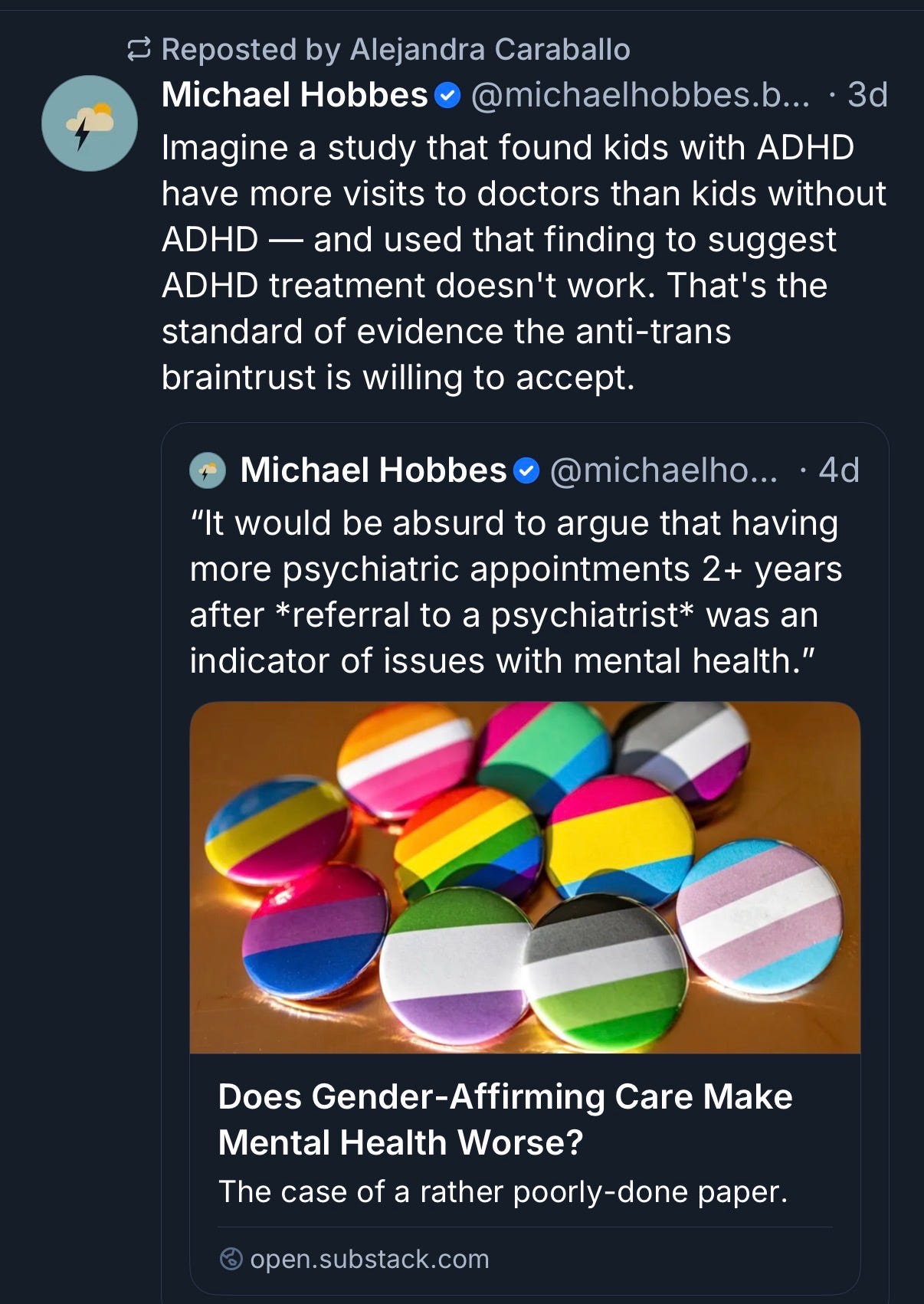
Lastly, Dr. Laura Targownik, a Canadian clinician researcher wrote a long and detailed criticism of the Finnish paper on her Substack, The Data Driven Trans Doc. While she also critiqued the study’s outcome variable, overall, her criticisms were much more sophisticated than Health Nerd’s, as were Ms. Reed’s for that matter.
I published a Substack about the study the day it came out, April 4. And since then I’ve reported out an article for The New York Sun, which ran today and I encourage you to read. In that article, I delved into the strengths and limitations of the study. For my reporting, I sought detailed comments from Dr. Kaltiala as well as Mikael Landén, a coauthor of Sweden’s 2023 systematic review on pediatric gender medicine and a principal researcher in medical epidemiology and biostatistics at the Karolinska Institute in Stockholm.
To try to flesh out people’s understanding of this study and to respond to some of the criticisms, I’m including below a full Q&A with both these Nordic researchers. I have tidied up the language ever so slightly to account for translation issues.

Dr. Kaltiala
Is it fair to say that just by virtue of having contact with GIS [gender identity services—ie: the gender clinic] and undergoing GR [gender reassignment], the youth in the study cohort would be more likely to be referred to a specialist psychiatrist than someone in the general population, even if they had similar psychiatric comorbidity?
No. Specialist level psychiatric treatment is provided in case of severe mental disorders, and the need is assessed with national equity criteria that exist to maintain equal access across the country. Referrals to specialist level psychiatric services by different referring agents (such as primary care, GIS, occupational health, student health, private practitioners) are assessed similarly regardless of where they come from.
