
Surgeon General Nominee Casey Means' Reasons For Quitting Her Residency Have Stayed Consistent Since She Left OHSU, Internal Emails Show
I obtained emails through a public records request indicating that Dr. Means told her residency she was dropping out due to disenchantment with surgery and a preference for prevention-based medicine.

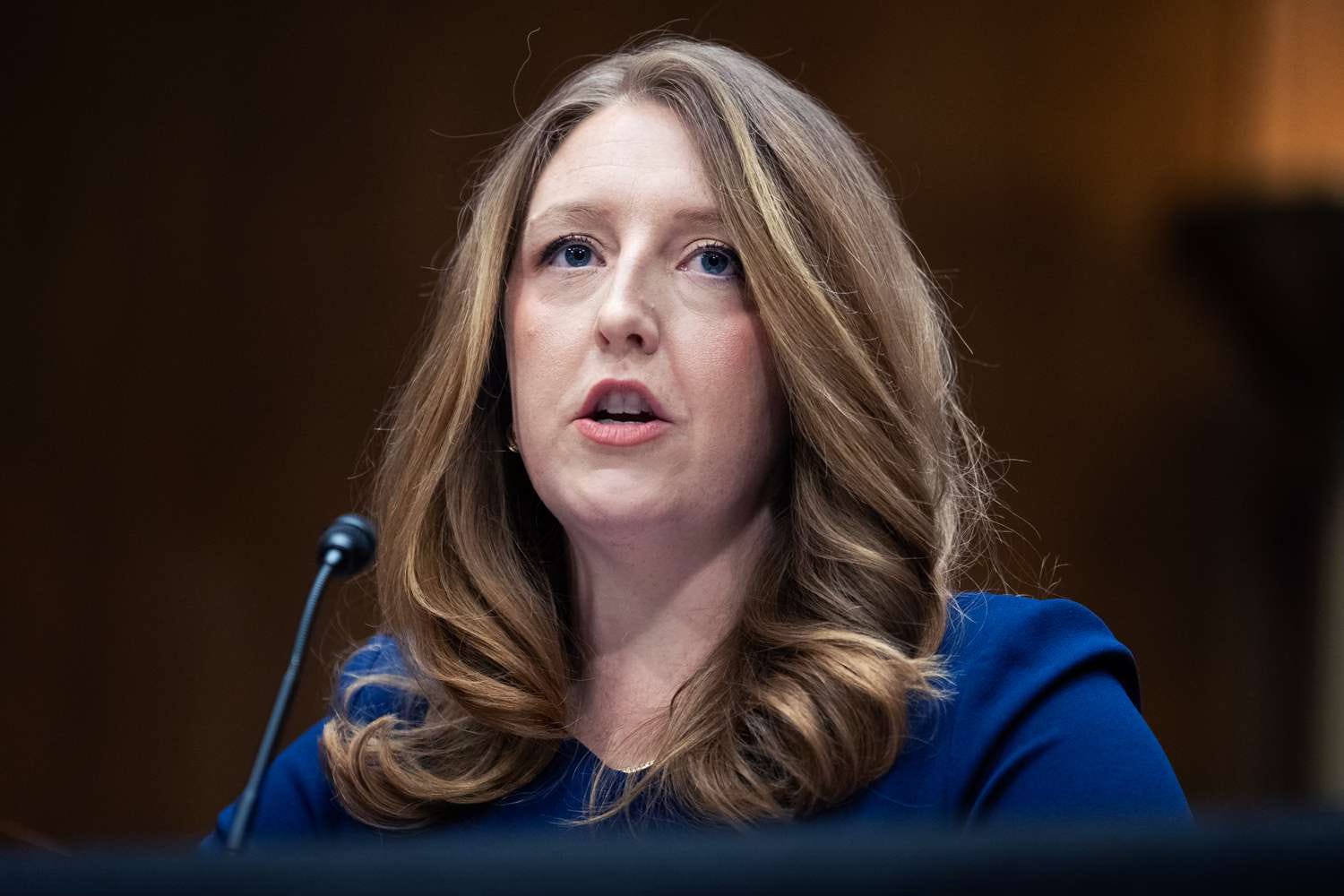
Casey Means, the wellness influencer and President Trump’s nominee for Surgeon General, has remained consistent in the reasons she has expressed for dropping out of her surgical residency since she made the decision to do so in 2018. That is according to internal emails I obtained through a public-records request from Oregon Health & Sciences University, where Dr. Means was a resident in head & neck surgery, also known as otolaryngology, until departing from the program at the outset of her fifth and final year.
The emails I obtained indicate that, as Dr. Means has said since her nomination last year to become the nation’s so-called top doctor, she left her residency because she was disenchanted with surgery and preferred a career path that focused on preventive medicine. She indeed followed through on that preference. Dr. Means, along with her brother, Calley Means, hit it big in 2024 with their book, Good Energy: The Surprising Connection Between Metabolism and Limitless Health. Mr. Means became a top advisor to Robert F. Kennedy, Jr. and an engine behind the so-called Make America Healthy Again, or MAHA, movement.
At her confirmation hearing on Wednesday, Dr. Means weathered scrutiny from members of the Senate Health Committee for not holding an active medical license.
Sheryl Gay Stolberg and Dani Blum reported in The New York Times:
Dr. Means rose to prominence with a biography that included a successful academic career toward becoming a surgeon. But she did not complete her residency, and has said that she was disillusioned with mainstream medicine, which she views as too focused on treating sick people and not enough on keeping them well.
This is in keeping with what Dr. Means told her superiors at OHSU in 2018, according to the emails I obtained. These documents also indicate that Dr. Means, despite having recently taken a leave of absence from her residency to reflect on her future, remained in good standing with the program at the time of her departure in September 2018. She apparently scored well on a recent assessment. In all the documentation I obtained, her superiors spoke well of her. Their exchanges were quite good natured, sprinkled with exclamation marks and well wishes, as well as the requisite deference of a medical resident—or former resident—toward her busy former superior.
The earliest emails I obtained were from May 12, 2018. They imply that Dr. Means had had some work to do to raise her scores from the previous year. But with some help, she did so.
Dr. Myriam Loyo, who today is an associate professor of otolaryngology at OHSU, reported that Dr. Means had raised her “overall in-service score” from the previous year. This put her in a position to study for her boards during what, come fall, would be her fifth and final year of residency.
In response, Dr. Carol MacArthur, who today is chief of pediatric otolaryngology at OHSU, replied: “Miriam [sic]. Thank you for your selfless gift of service to casey. What a success.”
Dr. Mark Wax, director of otolaryngology at OHSU, chimed in: “Yah she really pulled it in and brought her scores up to a wonderful level. She worked hard and she accomplished her goals.”
On June 5, 2018, Dr. Wax emailed a doctor in the Northeast, whom he addressed as “Lee,” to ask after job opportunities in the region for Dr. Means. This email suggested that Dr. Means had already indicated she did not wish to go into surgery following her residence. “She is interested in more of a medical and less of a surgical practice,” Dr. Wax wrote.
Later that month, Dr. Wax emailed Dr. Means with the log hours for the weeks she missed while on leave, suggesting that she had been away for 19 weeks. She would need to make up 13 of those weeks after the official end of her residency’s fifth year in mid-2019, he wrote.
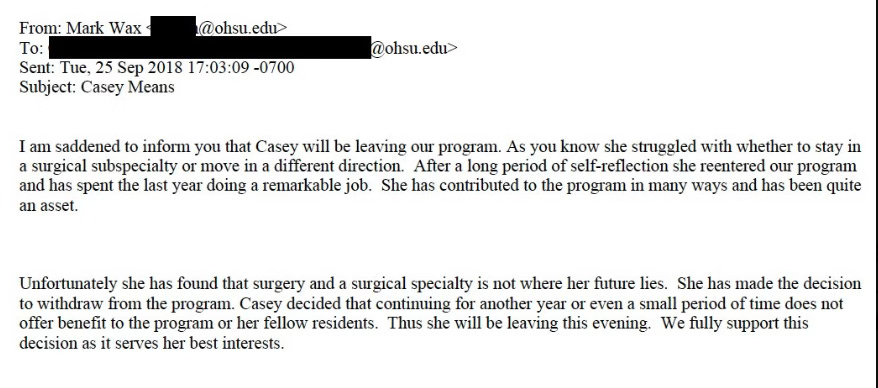
But then, on Sept. 25, 2019, Dr. Wax emailed a roster of otolaryngology attending physicians to inform them that he was “saddened” to announce that Dr. Means would be leaving the residency program.
“As you know she struggled with whether to stay in a surgical subspecialty or move in a different direction,” Dr. Wax wrote. “After a long period of self-reflection she reentered our program and has spent the last year doing a remarkable job. She has contributed to the program in many ways and has been quite an asset.”
“Unfortunately she has found that surgery and a surgical specialty is not where her future lies,” Dr. Wax continued. “She has made the decision to withdraw from the program. Casey decided that continuing for another year or even a small period of time does not offer benefit to the program or her fellow residents. Thus she will be leaving this evening. We fully support this decision as it serves her best interests.”
Dr. Wax had nothing but good things to say about Dr. Means’ time as a resident. “I have personally enjoyed my interactions with Casey over the years,” he wrote. “She has been an [sic] the exemplary physician, provided great patient care and contributed in a positive manner to all. This was a difficult decision but in the long run, as you know, I always advocate for what is best for the resident, just as we all advocate for what is best for the patient. I have faith that she will accomplish great things in her future career and I look forward to her continuing to communicate with us.”
Then, on Nov. 2, 2018, Dr. Means wrote Dr. Wax to ask for his help obtaining licensure from the Oregon Medical Board to allow her to moonlight as a physician. She needed verification from him regarding the time she completed in residency. She relayed to Dr. Wax that on the application form, she had detailed her reasons for leaving her residency as follows:
“On 9/28/2018, I voluntarily resigned from my residency program, during my fifth (chief) year of residency at Oregon Health & Science University in the Department of Otolaryngology Head & Neck Surgery. Throughout my years of residency, it became clear to me that despite my growing competency in the specialty, I was not professionally or personally satisfied in a surgical subspecialty, and that my primary interests and passions in healthcare are non-surgical and prevention-based medicine. While I had explored the option of switching specialties earlier in my training (and had taken a 3 month leave from residency during the beginning of my 4th year of residency in part to examine my desire to remain in a surgical specialty, and explore alternative specialty options and research opportunities), I ultimately had elected to continue in Otolaryngology Head & Neck Surgery. Approximately 1 year later, nearing the end of my residency and in the process of discussing specific job opportunities with employers, I became more convicted that I did not intend to pursue a post-training career in Head & Neck Surgery and that investing my time in the completing my remaining year of training (year 5) was not going to be beneficial. Given this, I elected to resign from my program.”
Dr. Wax seemed only too happy to assist his former protégée, writing, “Sure no problem! Glad you are Moving on and that you sound so Positive.”
To which Dr. Means replied: “All is well with me :) Still figuring out my plans, but making good progress. I may have to bug you down the road for other pieces of information from residency as I apply for things, but I really hope it’s not too much!”
Finally, on Dec. 2, 2018, Dr. Wax asked colleagues, “Does this look reasonable for her file????” It is not clear what he is referring to. But Dr. Paul Flint, who today is the chair of otolaryngology at OHSU, replied with an apparent reference to the reasons for Dr. Means’ departure: “I would include that this was for personal reasons and not related to performance or programmatic issues.”