
Jason Arday Apparently Plagiarized His Memoir Title and Origin Story From the TV Show 'Spartacus'
You can't make this up: The title of the apparent fabulist's memoir is the same as an episode of the TV show, and the book includes quotes from prophets that are similar to dialogue from the show.

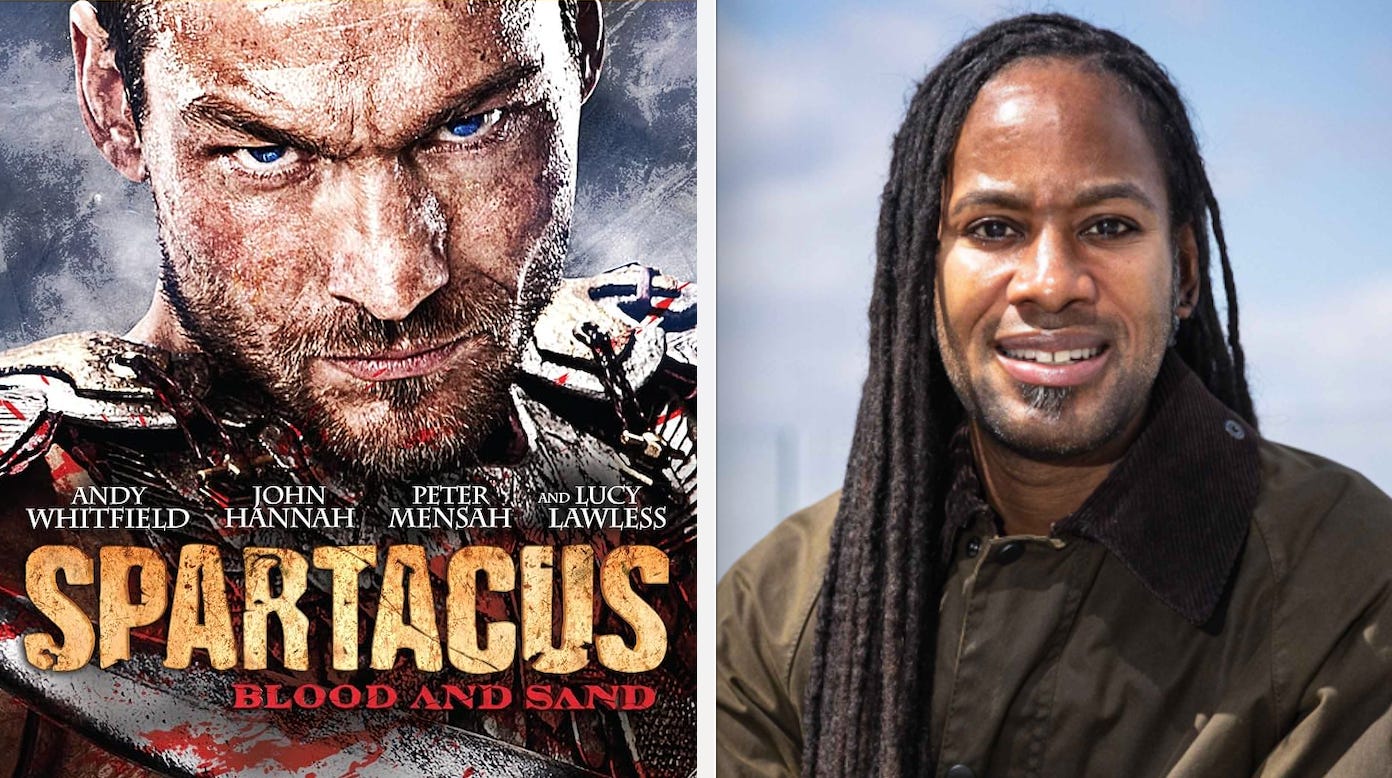
Just when you thought it was safe to go back to watching schlocky fantasy shows from the 2010s comes more news about Jason Arday’s alleged plagiarism: this time from pop culture.
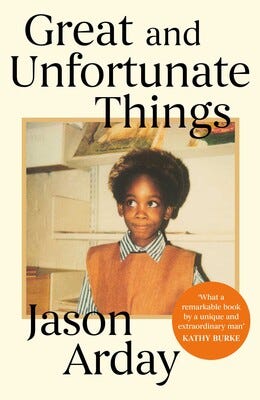
Mr. Arday, the apparent serial fabulist who resigned from Cambridge University last week amid credible accusations of academic plagiarism, shares the title of his upcoming memoir, Great and Difficult Things, and a key element of the origin story he recounts in its prologue, with the 2010 television show Spartacus: Blood and Sand.
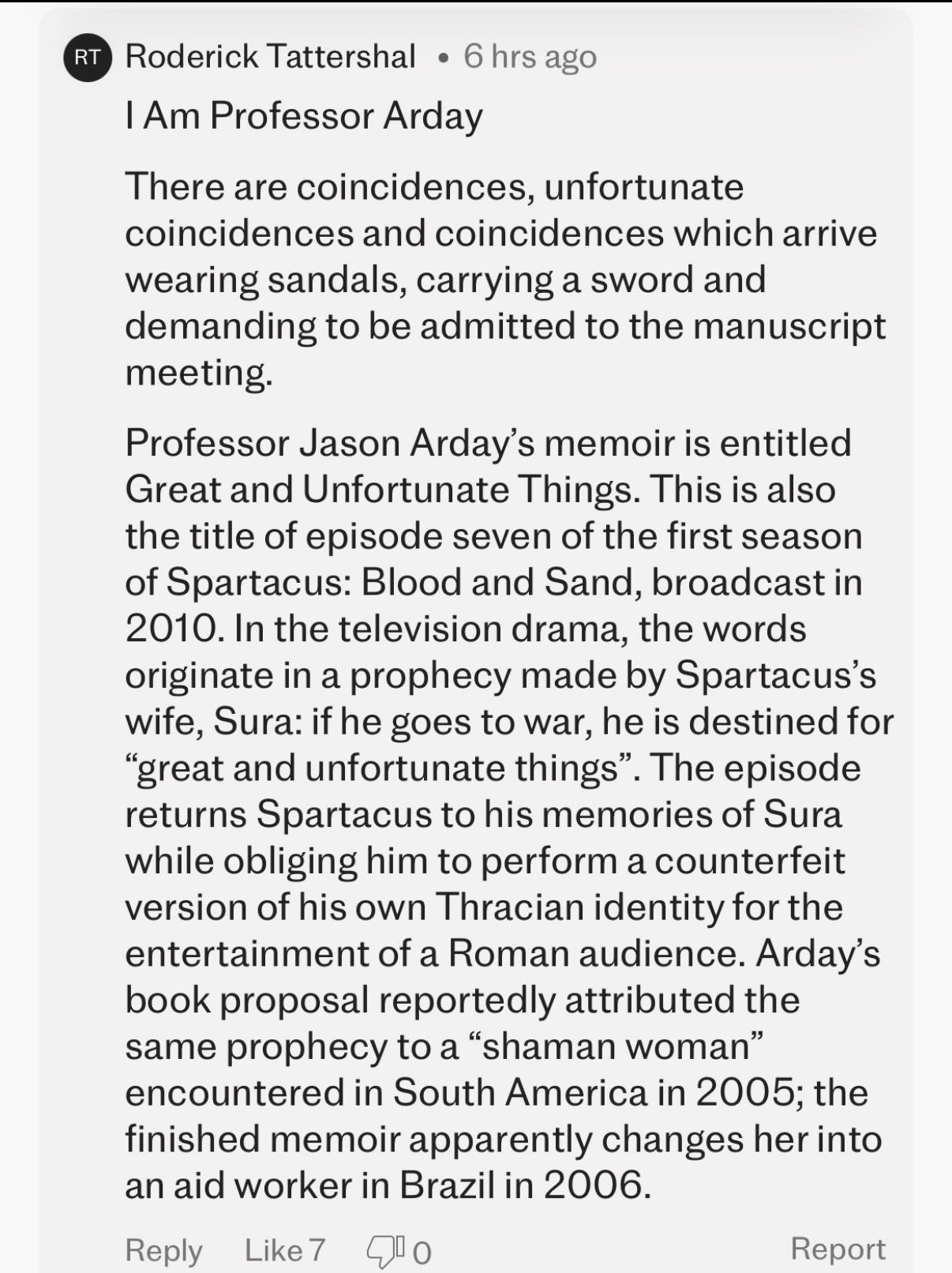
The news about Arday apparently plagiarizing from a TV show came to my attention thanks to the remarks below in the comment section of an article about Mr. Arday in The Daily Telegraph. This commenter appears to have gleaned these remarkable insights from a report on Thursday in Just the News.
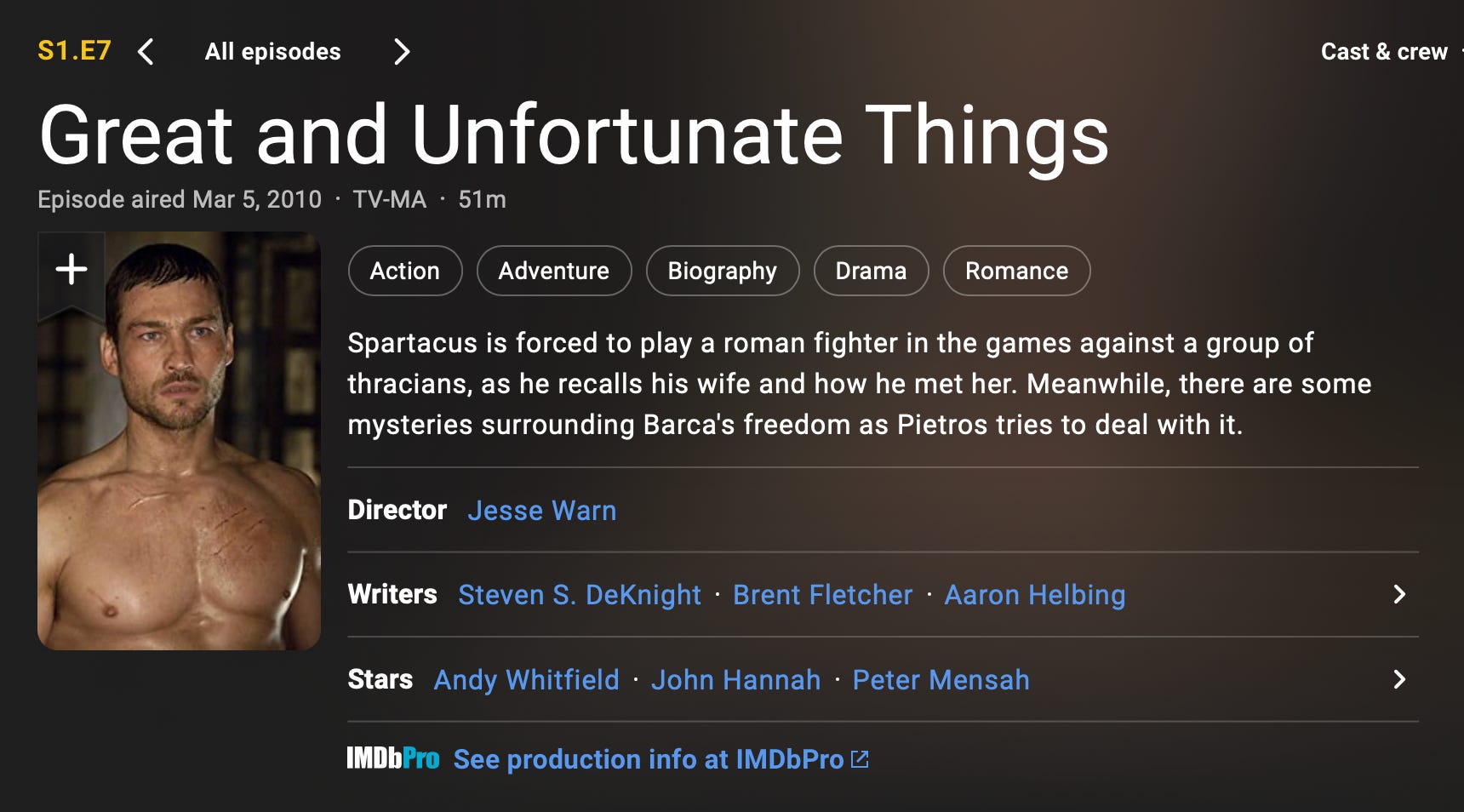
Season 1, Episode 7, of Spartacus is entitled “Great and Unfortunate Things.”
From that episode of Spartacus comes dialogue that overlaps with not one but two prophesies about his destiny uttered in the prologue of Mr. Arday’s book. In the TV scene, Spartacus’ wife, Sura, utters a prophesy:
SURA: The gods came to me last night, in my sleep.
SPARTACUS: What did they show you?
SURA: My husband on his knees, bowing before a great red serpent, the life draining from his veins.
SPARTACUS: What meaning did you take from it?
SURA: A warning. If you go to war you are destined for great and unfortunate things.
SPARTACUS: The Geti worship the mountain wolf. They place no faith in snakes. It was just a dream.
SURA: And if it isn’t?
(Also check out the film clip I obtained of Mr. Arday lying on TV to gain major prizes. See below.)
Spartacus was part of the memoir’s own origin story. Daniel Engber reported in The Atlantic, the following about the contents of Arday’s original book proposal, which Mr. Engber obtained:
Then there is the prophecy—the revelation Arday was given in Brazil, that he would suffer greatly and also do great things. According to the proposal, this occurred in 2005, not 2006, and the message came not from a local aid worker in her 30s but from “an elder in the small town where I had been assigned, who was well-known in the area for predicting people’s futures.” (Later in the proposal, he calls this person a “shaman woman.”) “Do you know the story of Spartacus, the escaped slave who led a rebellion against the Romans?” this town elder asks, before telling him his fate in minute detail. “Every event she described,” Arday writes in the proposal, “has since come to pass.”
Below is how the prophesies about Mr. Arday appear in the prologue of his book, per the final UK edition, typeset in June. Instead of citing Spartacus explicitly, the characters in the book merely appear to effect dialogue from the show.
First there is the scene of Mr. Arday’s birth in 1985, in which the midwife pronounces to his mother, called Giff: “This boy is destined for great things.”

Then comes the scene in Brazil, where Mr. Arday claims he went to aid in providing fresh water to children. There, a local prophet says to him in Portuguese through a translator: “I can tell you’re destined to do great things. But I also believe you’re destined for very sad and difficult things as well.”

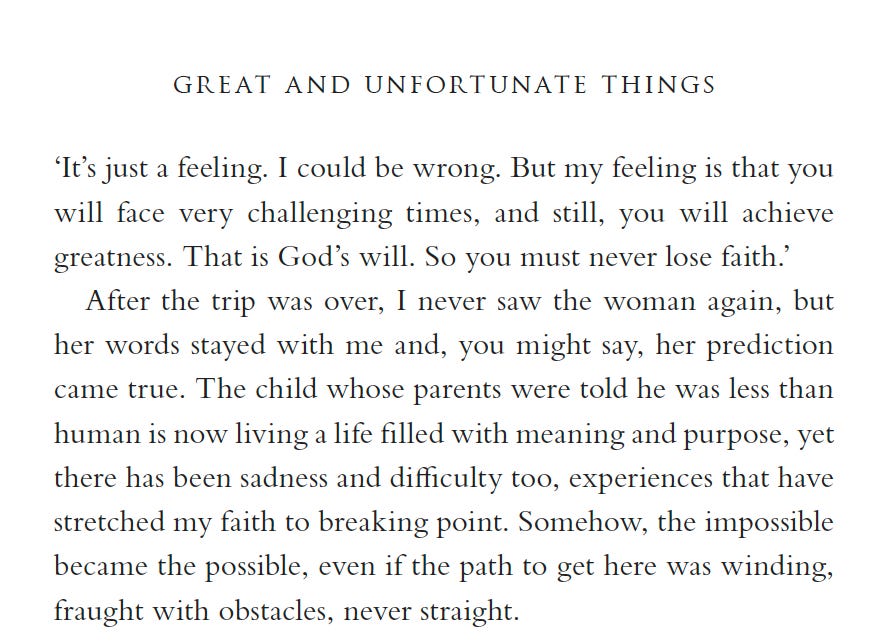
The Telegraph contacted the water charity Arday claims to have worked with, WaterAid. The nonprofit says it never sends aid workers abroad, suggesting that he never actually went to Brazil for the charity outing in question.
In the Spartacus series finale, Episode 10, called “Victory,” the dialogue: “Great and unfortunate things. What meaning do words carry? A warning, given voice by loving wife. To a man who no longer exists.”
It’s not uncommon for books or films to borrow words from other works of literature, or TV as the case may be. Just think of all the movies that have titles borrowed from Hamlet alone. But there’s borrowing, there’s paying homage, and then there’s stealing. Mr. Arday provides a list of sources in the back of his book, including his constant references to the Rocky franchise (he relates to Balboa).
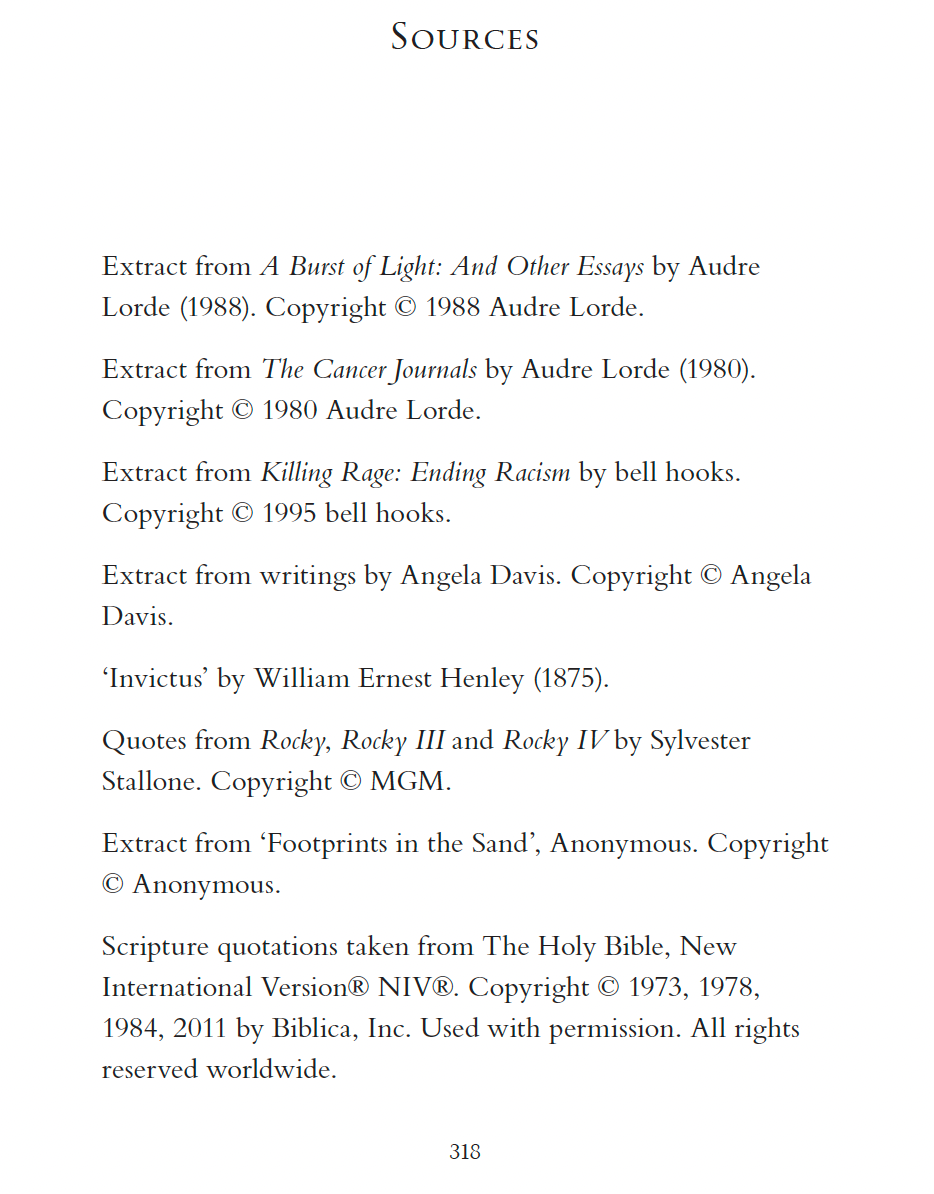
There is no mention of Spartacus in his source list.
Mr. Arday’s book is a vain, solipsistic auto-hagiography that concludes its tale when he reaches the pinnacle of success: getting the job at Cambridge in 2023. So now that he has gone and lost that job, the book’s premise falls apart the minute you pick it up.
And yet, despite swirling suggestions that Mr. Arday cannot be trusted to tell his own life story, Simon & Schuster has stuck with him and is slated to publish his memoir in the U.S. on Tuesday and in the U.K. on August 27. (They did not immediately return a request for comment. I have asked them repeatedly why they are willingly setting up a redux of the James Frey scandal.) As I reported for the Free Beacon, between the January 2026 U.S. proof and the June 2026 final U.K. edit of the book, both of which I obtained, the publisher made a number of key edits that together have the impact of softening his reputation and taking out what could be fodder for the accusations that he plagiarized his academic work or was out of his depth intellectually in the academy.
The year 2010—when Spartacus aired—is critical in Mr. Arday’s broader origin story, because that is when he has claimed, including in the memoir, that he ran 30 marathons in 35 days to raise money for charity. He also has claimed he subsequently ran 300 miles in three days and 600 miles in six days and raised £5.5 million for charity. There is only scant documentation of his marathons and no evidence of him running hundreds of miles. To wit, in his book, he makes no mention of such athletic feats, nor does he claim to have raised millions. He admitted to The Times after the plagiarism accusations blew up last month that he did not, in fact, raise all those millions. Instead, he claimed he raised money as part of larger teams. But he declined to name the members of such teams to The Guardian, claiming he signed NDAs. The only evidence I could find in my reporting for The Washington Free Beacon that he raised any money suggested he raised no more than £10,800 for one charity and an unclear amount for a second.
Further examining the engines of Mr. Arday’s myth making, I have obtained a recording from a speech that Mr. Arday gave at a British university last year in which he spoke about his mother’s love of Greek mythology. He recalled when he was about 19, she told him the legend of Spartacus. “And she said, ‘You know, Spartacus was a rebel. He was a rebel leader. He was a freedom fighter. She’s talking about this lineage of freedom fighters, and obviously it led towards my personal favorite freedom fighter, Nelson Mandela, and obviously Winnie Mandela as well.”
This isn’t the only time that Mr. Arday compared himself with Nelson Mandela. There was also a 2023 episode of the Full Disclosure with James O’Brien, in which Mr. O’Brien said that Mr. Arday was “motivated entirely by the impact that you have on others or the changes that you bring about in other lives.” Mr. O’Brien said this was likely why Mr. Arday named checked during the interview others who have so inspired him. Mr. Arday then spoke of how much Nelson Mandela in particular inspired him.
“His greatest quality was how he made people feel,” Mr. Arday said.
I am an independent journalist, specializing in science and health care coverage. I contribute to The New York Times, NBC News, The Free Press, UnHerd and The New York Sun. I have also written for the Washington Post, The Atlantic, The Guardian and The Nation, among many others. Follow me on X: @benryanwriter. Visit my website: benryan.net
He is Spartacus!
I applaud your tenacious pursuit of this chancer (any sympathy for his public exposure nuked once his signature tendency to run to the police / expensive lawyers was exposed). Some good may (doubtfully) come of all this (we may be too far gone). Laughter is a good antidote, however. On the edge of my seat here 🍿