

When New York City’s Mt. Sinai Health System reached a settlement with the Justice Department last week to keep its pediatric gender clinic closed, much of the public debate over why the hospital had capitulated focused on the Trump administration’s efforts to obtain patient records via subpoena. This overlooked the mounting efforts by Republican lawmakers more broadly and the Trump administration in particular to leverage accusations of fraudulent medical billing to target doctors in this field and drum them out of providing gender-transition interventions to minors.


A spokesperson for Mt. Sinai said last week: “The settlement is complex, but at its core reflects Mount Sinai’s commitment to safeguarding our patients’ confidential information and protecting our clinicians.”
Those last few words, protecting our clinicians, at least theoretically could refer to protecting clinicians from prosecution or civil lawsuits for the use of non-gender-identity-related diagnosis and procedure codes when seeking reimbursement for puberty blockers, cross-sex hormones or gender-transition surgeries to treat gender dysphoria in minors.
Last year, I obtained several hundred videos from conferences held by the World Professional Association for Transgender Health and its US affiliate, USPATH, between 2021 and 2023. These videos were subject to a subpoena by the Alabama attorney general, Steve Marshall, as part of his defense in a lawsuit against the state’s ban on gender-transition interventions for minors. I covered how these videos portrayed the besieged field of pediatric gender medicine in a report for Compact magazine earlier this year and have been serially publishing key videos on my Substack since then.

I have newly scoured these videos for conference speakers addressing the use of alternative procedure or diagnosis coding in transgender care. I found a number of examples, video clips of which I have published and analyzed below. None of them included speakers specifically referring to minors in the moments when they made such references to coding choices, mind you. But in at least some cases, the wider context of their presentations or their response to audience questions did not rule out that minors could be included in what they were suggesting or recalling about coding practices.
In American medicine, physicians use diagnosis codes from the ICD system, which specify the condition being treated, and procedure codes known as CPT codes, which indicate the actions the physician took to treat the condition. These codes are integral to obtaining reimbursement for services. Insurers require diagnosis codes to serve as an appropriate justification for the corresponding procedure.
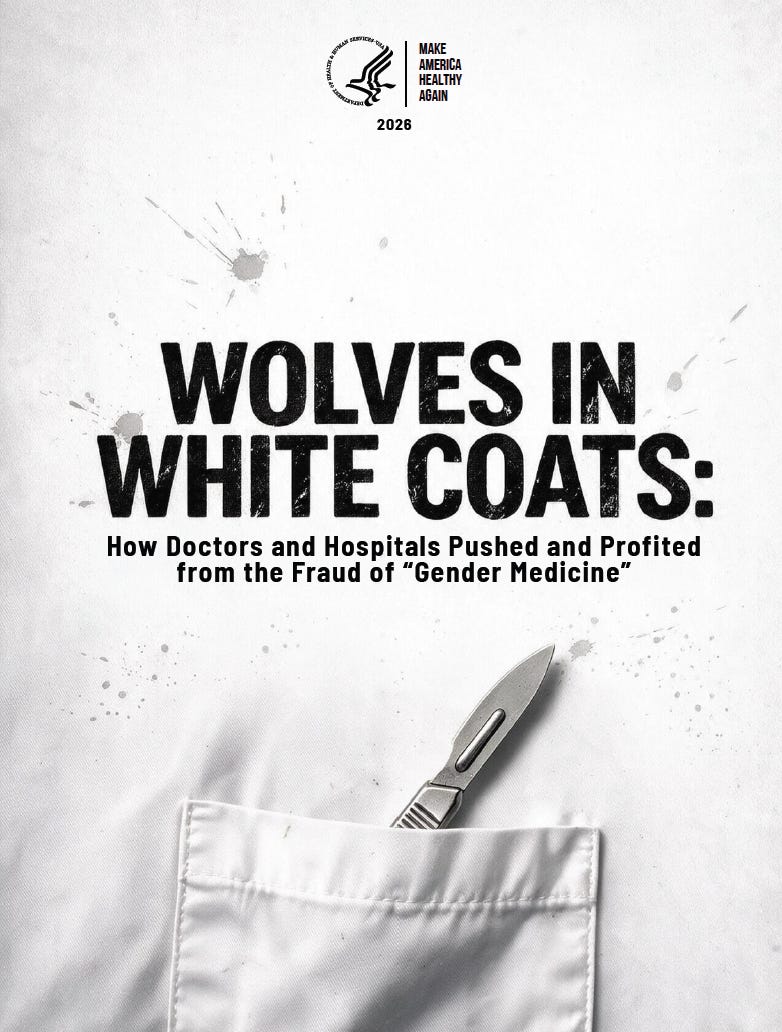
The U.S. Department of Health and Human Services on Aug. 13 published a scathing report bearing the incendiary title “Wolves In White Coats: How Doctors and Hospitals Pushed and Profited from the Fraud of ‘Gender Medicine.’” Much of the report is devoted to examining how leaders in pediatric gender medicine advocate the use of alternate codes when seeking insurance reimbursement for gender-transition interventions. These practices, the report asserts, have become widespread in this field.
The report serves as an ominous warning to health care providers still practicing in what remains of a field that the Trump administration has seen considerable success in destroying outright.

“When healthcare providers use fraudulent medical coding to obtain payment from the federal government,” the HHS report asserts, “they may be liable under the federal False Claims Act, which carries fines and imposes damages of ‘3 times the amount of damages which the government sustains.’”
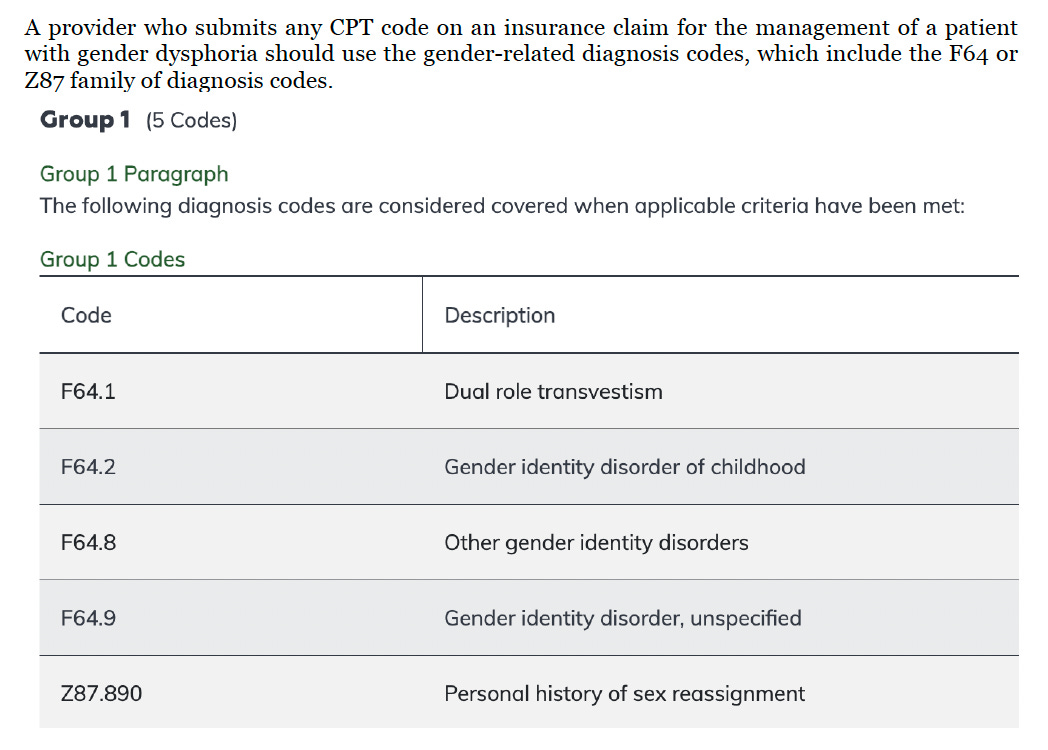
To follow federal regulations, the report asserts, physicians treating patients for transgender-related purposes are meant to use a number of ICD diagnosis codes related to gender identity, sex reassignment or “dual role transvestism.”
But it has become common for medical providers to use alternate diagnosis codes, according to the report—in particular those related to endocrine disorders.
This includes, the report states:
“Endocrine disorder, unspecified,” coded as E34.9. Using this code in place of a gender-related diagnosis (e.g., gender identity disorder, F64.0) violates CMS guidelines for the simple reason that gender dysphoria is not an endocrine disorder, since it exhibits no hormonal abnormalities. In fact, the only endocrine disorders these patients have are the ones created by their doctors through the use of sex-rejecting interventions.
Yet it appears that healthcare providers are misusing this code. In a 2016 study titled “Identifying the Transgender Population in the Medicare Program,” CMS’s Office of Minority Health acknowledged that proxy diagnosis codes are being substituted for gender dysphoria. In the methods section, the authors explain that they included the ICD-9 diagnosis code for Unspecified Endocrine Disorder in their analysis because it is “frequently used by the transgender community to combat the perceived stigma of a GID diagnosis.”
The report goes on to note that a 2023 study also finds such use of alternative billing codes.
The report further notes an analysis of medical-claims data by Leor Sapir, a senior fellow at the Manhattan Institute who studies pediatric gender medicine, that found an almost 30 percent increase in endocrine disorder, unspecified diagnoses in minors between 2020 and 2022. Dr. Sapir asserted in 2025 that this was likely the product of a “greater willingness” by medical providers to use endocrine disorder codes over gender identity disorder codes in pediatric care of patients with gender dysphoria.
The authors of the HHS report analyzed health insurance databases covering 2015 to 2025 and found that insurers were billed nearly $50 million for puberty blockers for patients age nine to 17 under endocrine disorder codes, excluding precocious puberty. There was nearly $11 million in billing for 13- to 17-year-olds using a precocious puberty diagnosis code.
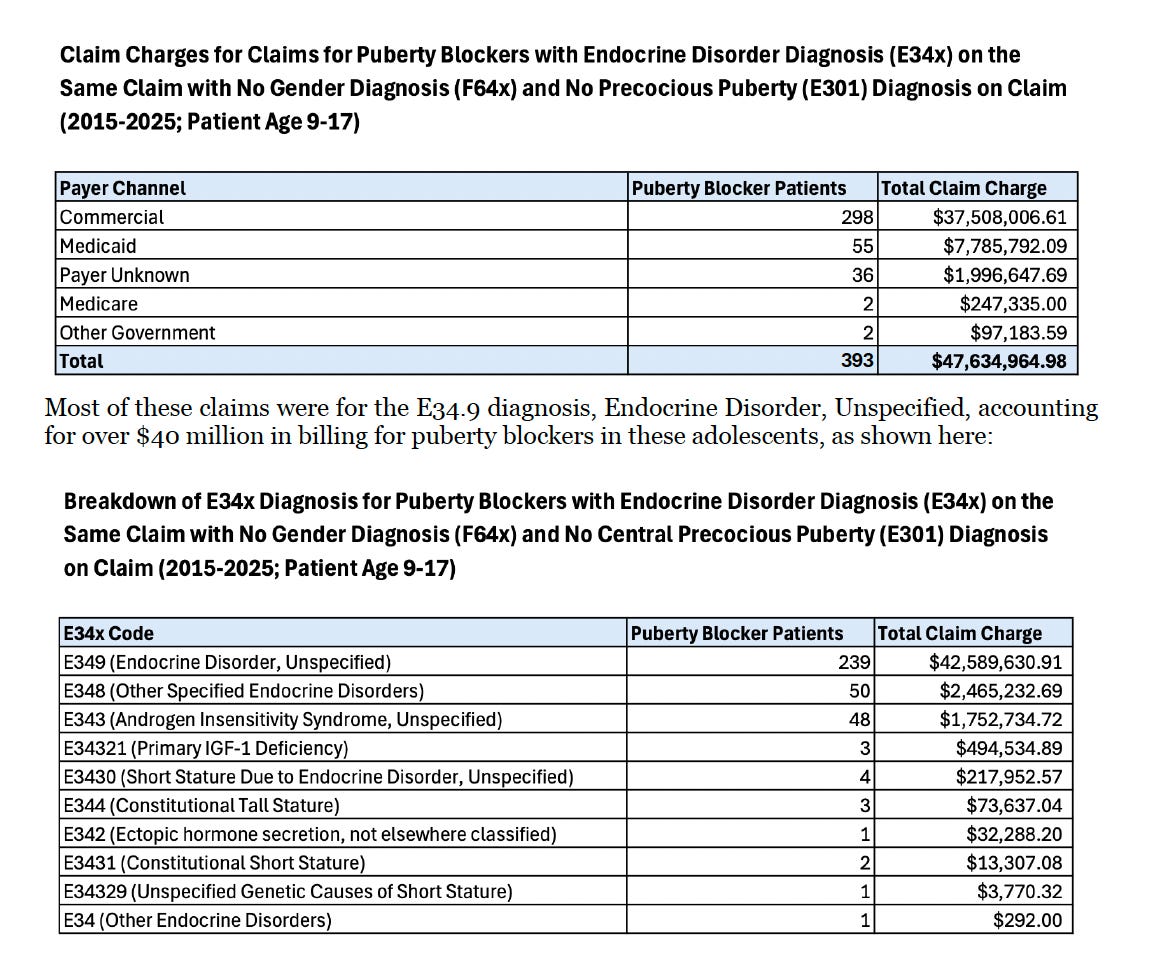
The report asserts that “this data strongly suggests a pattern of potentially fraudulent billing that relies on miscoding for endocrine disorders to justify the prescription of puberty blockers.”
WPATH, the report goes on to state, has promoted “the misleading use of several ICD-10 codes” in its training presentations.


WPATH Conference Videos
Below are the WPATH conference videos I found that make reference to alternative coding.
Teddy Goetz
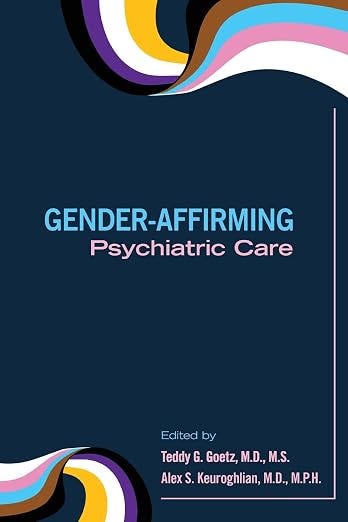
Dr. Teddy Goetz is a psychiatrist who currently works at the Mid-Atlantic Permanente Medical Group. Dr. Goetz, who identifies as nonbinary, was a coeditor of a controversial text put out by the American Psychiatric Association’s publishing arm in 2023 outlining how to apply the gender-affirming method to the care of what these days are known as gender-expansive patients.
Dr. Goetz spoke at USPATH’s 2021 conference:


