


Hazard Ratio is a reader-supported Substack. Consider backing my work and becoming a paid subscriber today.
During the 24 days between news breaking of Jason Arday’s alleged academic misconduct and serial lying and his death on Aug. 14, a blast radius extended across Cambridge University. In an apparent effort to respond to the mounting public outcry over Dr. Arday’s alleged plagiarism and academic fraud while containing the damage to the august institution’s reputation, Cambridge on Aug. 5 announced an investigation into Dr. Arday’s appointment.
In a statement on the expanding crisis for the university then issued Aug. 12, Cambridge Vice-Chancellor Deborah Prentice said she shared the “concerns” about Dr. Arday’s appointment. But she insisted that his case was an “aberration.”
Or was it—at least where the quality of his scholarship was concerned?
The PhD thesis of a student in Cambridge’s Faculty of Education—in which Dr. Arday held a professorial chair, in the sociology of education, until he resigned hours after the investigation announcement—has been put under what British and Canadian academics have told us is a remarkably long embargo, shielding it from public view until 2031.
Crucially, among the panelists who reviewed the thesis was Dr. Arday himself.
The thesis, which we have obtained and which we review below, raises important questions about whether the Faculty of Education, including Dr. Arday’s own contributions, let down the basic standards of higher education.
The lengthy embargo raises further questions about what Cambridge, which is among the most elite universities in the world, and the paper’s author might have to hide where her scholarship is concerned.
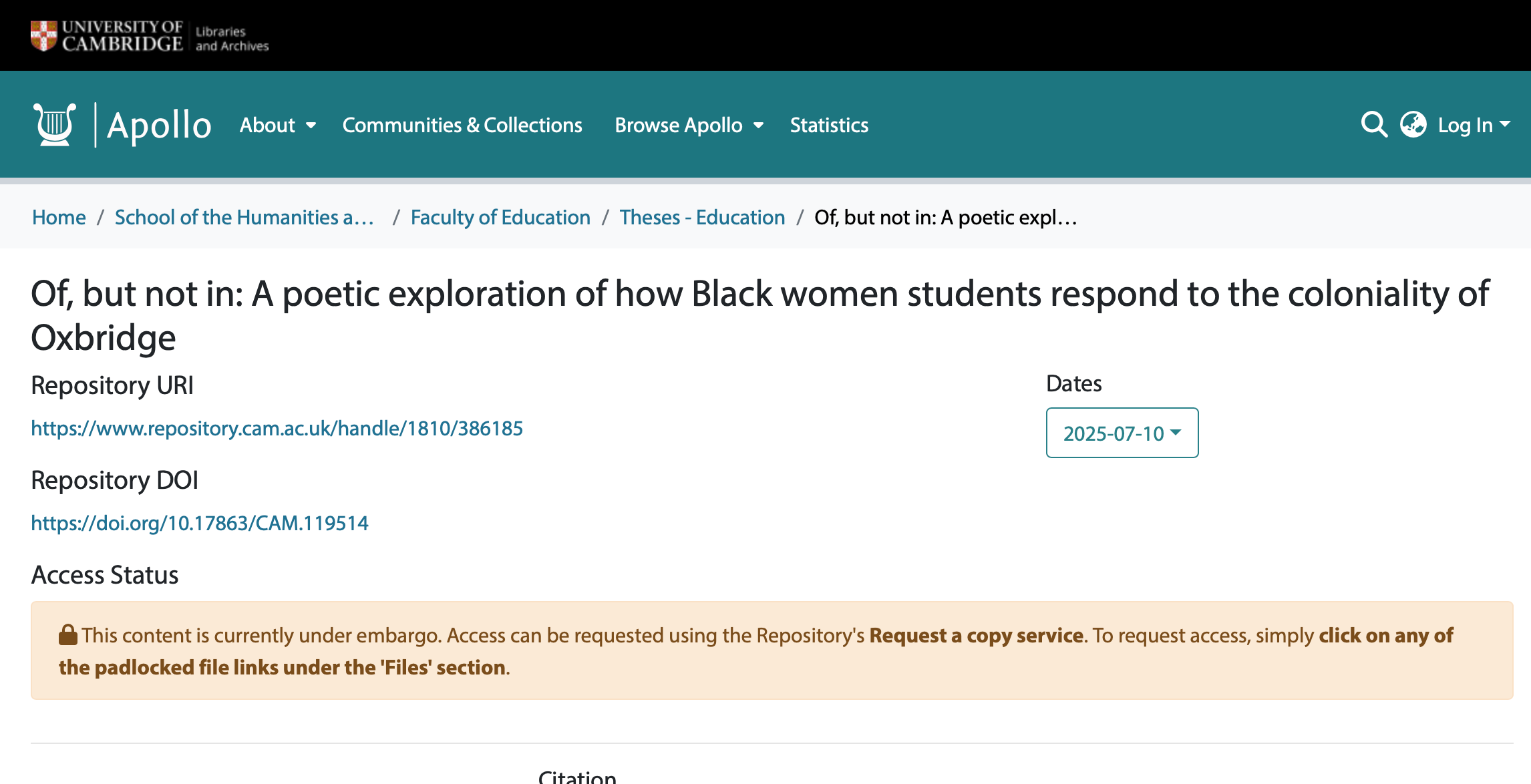
Written by Damilola Folayan, the thesis is entitled Of, but not in: A poetic exploration of how Black women students respond to the coloniality of Oxbridge—referring to the portmanteau of Oxford and Cambridge. It garnered her a coveted Cambridge PhD in 2025. Following what’s known as an autoethnographic style, it is in essence an epic poetry-slam interpretation of the plight of Dr. Folayan and three other black women at Oxbridge and their experiences navigating, with considerable ambivalence, these historically, and still overwhelmingly, white elite institutions.


The sprawling thesis unabashedly thumbs its nose at the rigors and demands of academia even as it demands in return an elite PhD and all the rights and privileges pertaining thereto.
The landing page for Dr. Folayan’s thesis was taken down on Aug. 14, just before news of Dr. Arday’s death broke. This followed our first submission via email of questions, earlier that day, to Cambridge and Dr. Folayan about her thesis. The landing page was put back online at some point in the subsequent weeks.
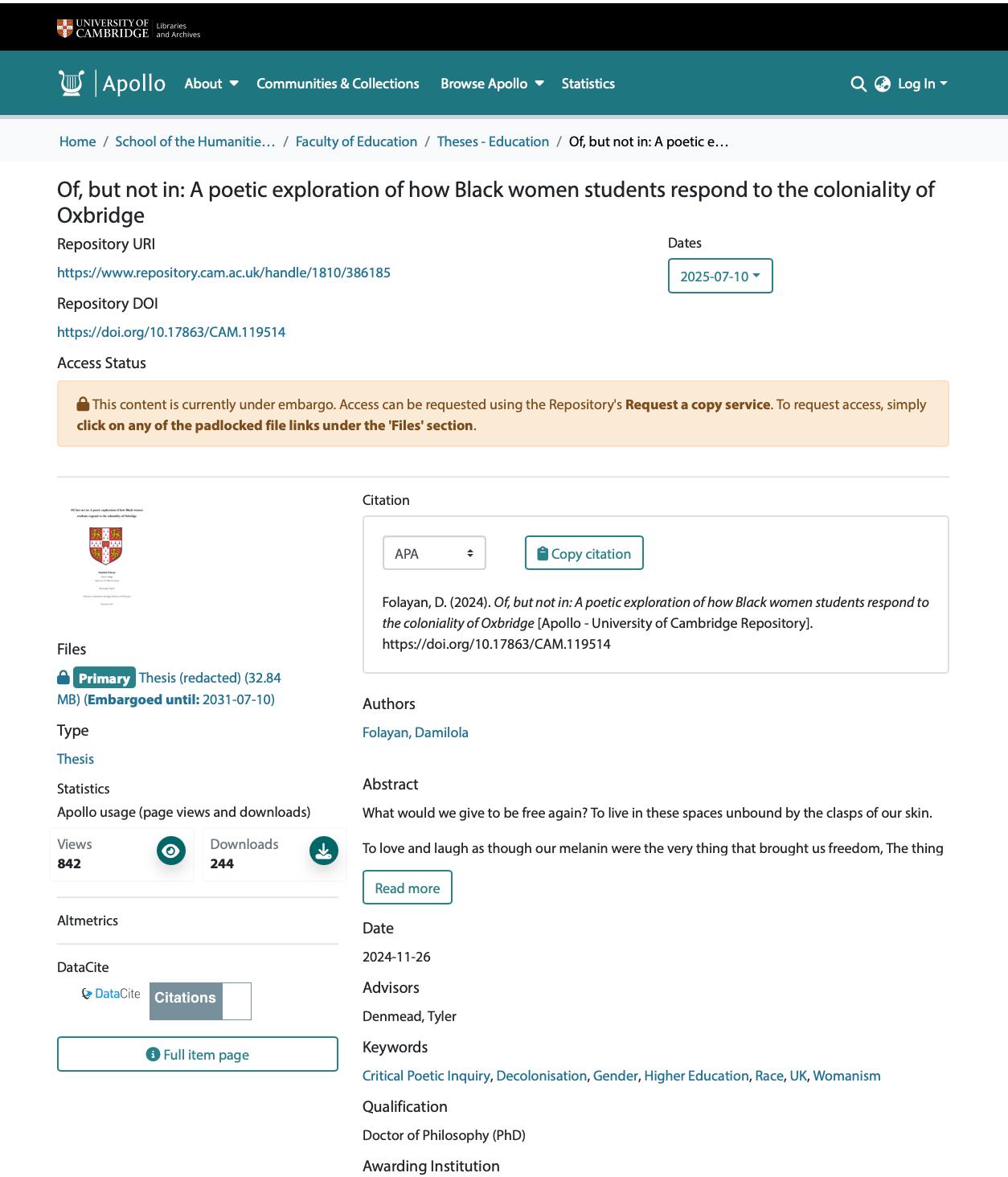
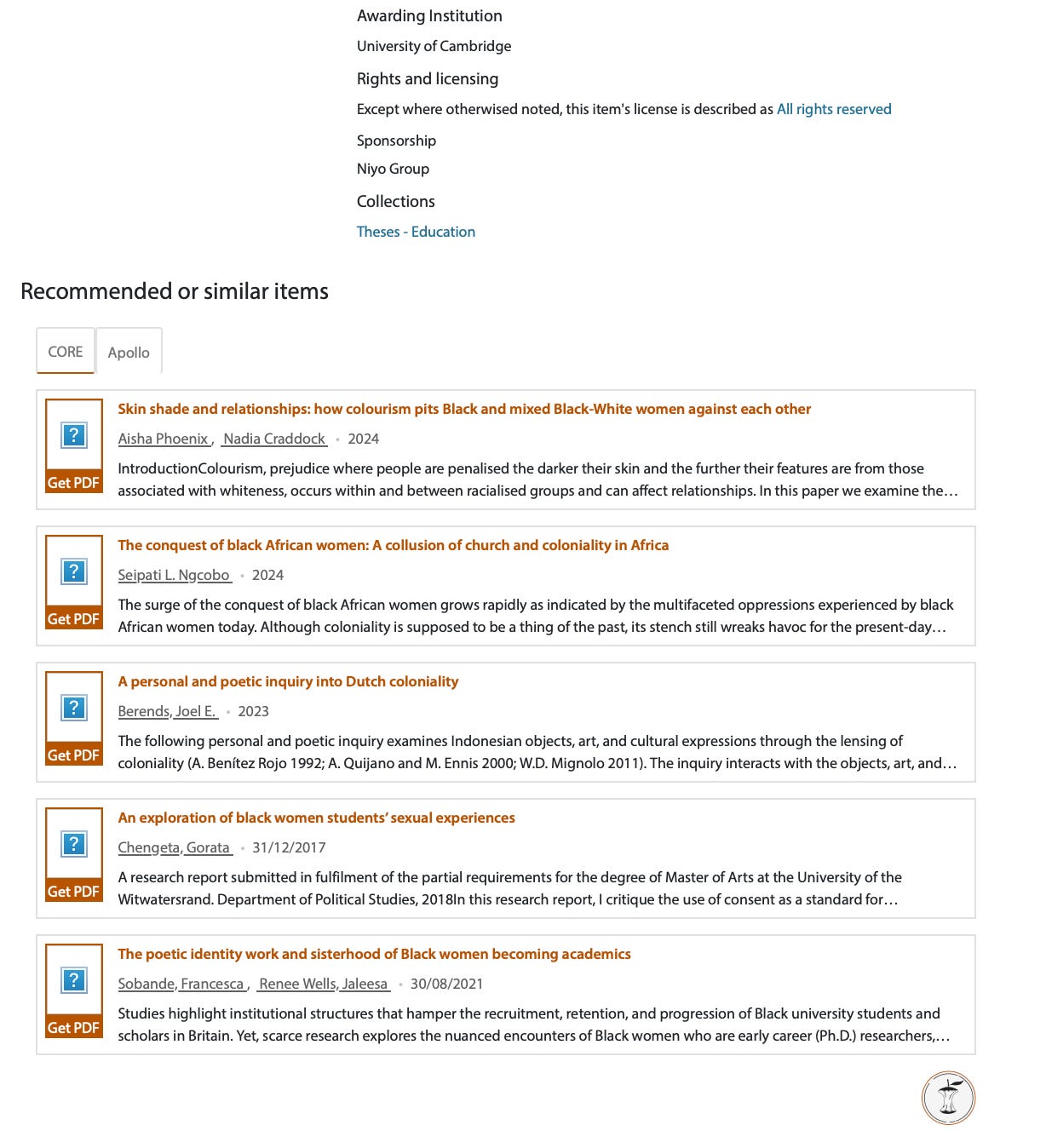
Dr. Folayan, who did not return requests for comment, submitted her thesis on Nov. 26, 2024, and it was published July 10, 2025. A source who monitored the thesis over this period informed us that the university placed the thesis under an initial one-year embargo. The particular type of embargo the thesis received, called embargoed access, permits the author to release copies upon request at their own discretion.

Various academics familiar with the British system told us it is not uncommon for a university to keep a PhD thesis initially under wraps like this, while, for example, its author seeks to publish it in book form.
But what happened next was more exceptional—and even an apparent violation of university policy—sources tell us.
At some point after July 27—the date when our source was able to freely download Dr. Folayan’s thesis, given it was not under embargo at that time—and before Aug. 9, the university placed a new, five-year embargo on the thesis. This shielded the document until July 10, 2031.
Various academics informed us that in rare cases, PhD theses may be put under lengthy embargos if they contain, for example, information that could violate an individual’s safety. But Dr. Folayan did not receive the type of stricter embargo that would be placed in those circumstances.
The embargo on Dr. Folayan’s thesis appears to violate Cambridge’s own rules for limits on such embargoes, which state: “The maximum embargo permitted is 6 years from the date of first deposit”—not from the date that the thesis was published, as is now the case for Dr. Folayan’s thesis. Given her deposit date, the university rules would appear to place the outer limit at Nov. 26, 2030, which is 226 days before the current expiration date on the embargo.

The records suggest that Dr. Folayan herself requested the embargo extension, given her thesis sits under “embargoed access.” Under this protocol, the thesis author completes an embargo extension form, which a university supervisor then signs (or if the supervisor disagrees, the degree committee weighs in). Or it could be that the university administration broke protocol and applied the embargo itself through this route.
Regardless, the length of the embargo raised eyebrows among our sources in British academia.
“I have never heard of a PhD being embargoed in the social sciences,” Alice Sullivan, a professor of sociology at University College London, told us in an email exchange that took place before Dr. Arday’s death. “Most students are keen to share their work.” She said that if a PhD thesis is shielded for many years, “it is unclear how it could count as a contribution to knowledge.”
A Cambridge spokesperson on Aug. 14 stated, on the contrary: “It is common practice for PhD students to request an embargo on their theses. There are a number of reasons why such a request might be made and in each case a standard protocol is followed.” The spokesperson did not respond to follow-up questions about whether Dr. Folayan’s especially lengthy embargo violated university policy.
The Arday plagiarism scandal broke in the Substack of Nathan Cofnas, an American academic who is a postdoctoral researcher at Ghent University in Belgium, on July 21—11 days after Dr. Folayan’s embargo lifted. Dr. Cofnas told one of us that he first alerted Cambridge to his investigation on July 16. Retraction Watch followed Dr. Cofnas’ article on July 27 with even more explosive reporting about Dr. Arday’s alleged academic misconduct and his apparently aggressive—and temporarily successful—efforts to leverage the legal system to intimidate those who questioned his scholarship and honesty and keep the damning story under wraps.
This means that the new, especially long embargo was placed on a PhD thesis—a piece of scholarship for which Dr. Arday sat on the review panel—after Dr. Arday’s alleged academic misconduct became a major public scandal.
The intense public focus on such offenses and the purported poor quality of Dr. Arday’s academic publications threatened to tarnish Cambridge’s historically sterling reputation. In particular, the Faculty of Education, in which Dr. Arday became the university’s youngest black professor in 2023, found itself under withering scrutiny.
Dr. Sullivan, who, according to her bio, studies “social and educational inequalities in the life course”—similar to the domains of Drs. Arday and Folayan—said that there were academics “doing good work” in Cambridge’s Faculty of Education at large. “I feel for them, because they will now be tainted by association with the Arday scandal,” she said—albeit before Dr. Arday’s death instantly changed the tenor of the public debate over his life and work.
But Dr. Sullivan offered a scathing and unsparing appraisal of Cambridge’s Faculty of Education, saying that “the department as a whole is surprisingly weak, particularly given the advantages of the prestige and perks of Cambridge, which should make it possible for them to hire the very best.”
Hilary Cremin, who heads the Faculty of Education and who in a 2023 BBC interview said that Dr. Arday was “the best in the world” in the research he did, was under particularly scorching scrutiny in the weeks before Dr. Arday’s death. Critics accused Dr. Cremin of pandering to Dr. Arday and overlooking what they asserted was his weak publication record in favor of leveraging his race to paper over Cambridge’s notable lack of diversity where black scholars are concerned.
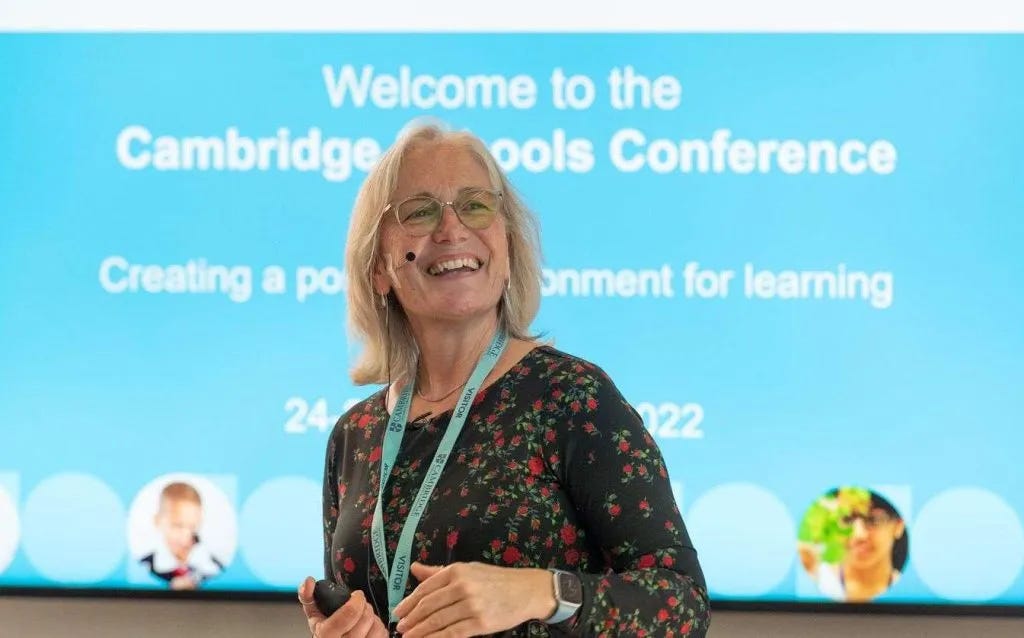
Dr. Sullivan said that Dr. Cremin “is not someone of the calibre you would expect to head a department at Cambridge.” She suggested that Dr. Cremin was a linchpin in appointing someone with an academic background as thin as Dr. Arday’s, saying, “One of the most important roles of a head of department is to sit on all senior appointment panels and ensure that weak hires are avoided. This is one reason that having an intellectually credible head is essential to a strong department.”
“I am concerned that students at Cambridge have been badly let down,” Dr. Sullivan said. “They deserve better.”
Dr. Folayan’s thesis: a poetic act of defiance
What is a PhD thesis supposed to accomplish? The answer can vary widely by discipline, but the basic expectation is that it is meant to represent a genuine contribution to or advancement of human knowledge. That knowledge doesn’t need to be timeless, like discovering the mass of a carbon atom. It can be narrowly focused. And research methods vary between disciplines. Formal experiments and statistical hypothesis testing are not appropriate or even possible in many fields. Social scientists, including anthropologists, sociologists and other qualitative researchers, often study highly subjective questions that can’t be answered with the tools and precision of the hard sciences.
Dr. Folayan’s thesis asks how black women students experience and respond to what she calls the “coloniality of Oxbridge,” which she describes as the persistence of colonial power, norms and racial hierarchy at Oxford and Cambridge. To answer that question, she relies on conversations she held with three black women who had attended or were attending Oxbridge, infuses their stories with her own experiences through so-called autoethnography, and ultimately spends 70,413 words analyzing the resulting material using so-called Critical Poetic Inquiry.